Hey there, Christophe from TheFrenchHerbal.
Let’s talk about a pretty little plant making pretty little flowers. Its name is cowslip, and you will find it just about everywhere in France and in many countries around the world. It displays its gorgeous little yellow flowers in the spring, and you can make a very good home remedy out of it. The flowers as well as the roots are medicinal. You guessed it, this episode is all about cowslip.
Before we start, a quick but important reminder: I am not a doctor, pharmacist, or licensed healthcare professional. The information shared in this episode is for educational and informational purposes only. It is not intended to diagnose, treat, or cure any condition, and it does not replace professional medical care. Always consult with your physician before starting any new herbal protocol, especially if you are pregnant, nursing, or taking medication.
Cowslip – The Plant
Let’s start with a bit of botanical information.
Cowslip is a perennial plant that belongs to the Primulaceae, the primrose family.
In France, we call it “primevère coucou,” or just “coucou” — cuckoo — because it shows up around the time you hear the first cuckoo of the year. Its Latin name is Primula veris. “Primula” comes from the Latin “prima,” which means “first.” And “veris” means spring. So, the first one of spring. It’s one of the very first flowers we see appearing in our countryside. And we’re very happy to see it, the yellow flowers make us think of the sun and the good days ahead.
Quick note for my American listeners: in the US, the name “cowslip” is sometimes used for marsh marigold (Caltha palustris), which is a completely different plant and a toxic one.
Also note that there are a lot of ornamental primroses out there in all kinds of colors. Here we’re talking specifically about Primula veris. That’s the one that was used in our tradition, so don’t confuse it with other primroses. Stick to the Latin name, Primula veris, learn to identify it, and you’ll be fine.
Our dear Paul-Victor Fournier, a French botanist who left us some beautiful works on plants, reminds us that some primrose species are toxic. On the other hand, some of them, like the oxlip, Primula elatior, can probably be used the same way as Primula veris. Fournier also mentions Primula acaulis, the common primrose, or garden primrose, because that’s generally the one you’ll see in gardens as an ornamental, and it probably has the same properties. That one is also called Primula vulgaris.
But let’s keep it simple. For the rest of this discussion, we will stick to Primula veris. It’s the safer route, and it’s the plant you’ll find in herb stores anyway, at least in France.
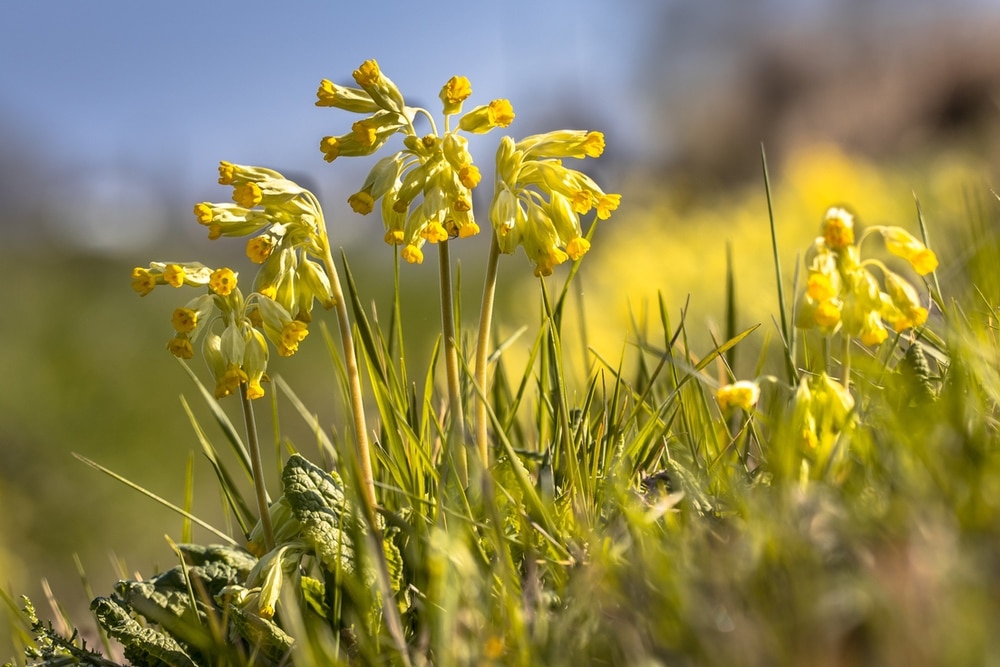
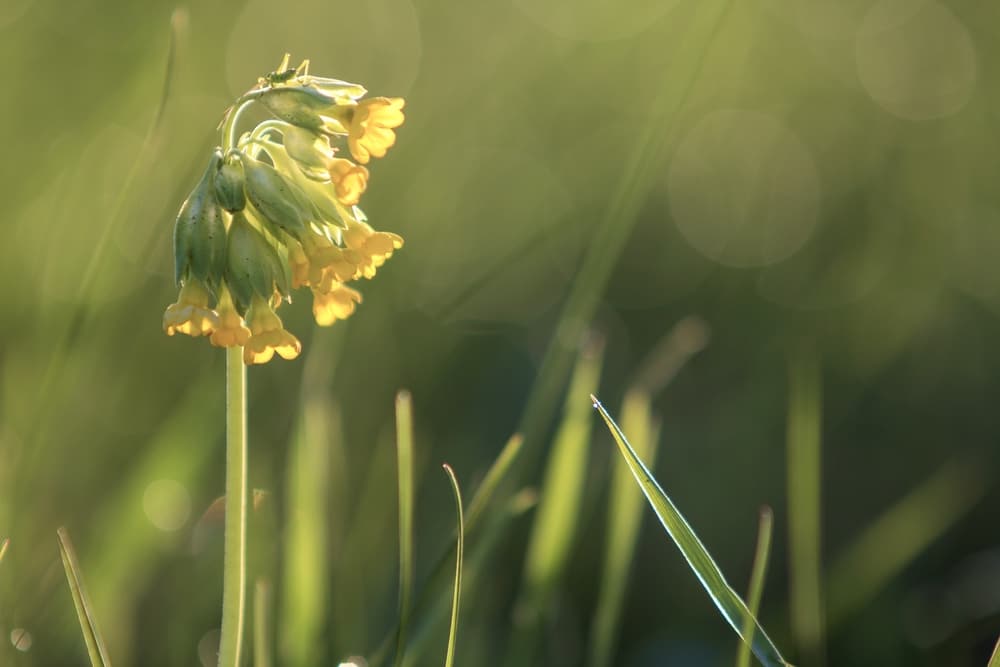
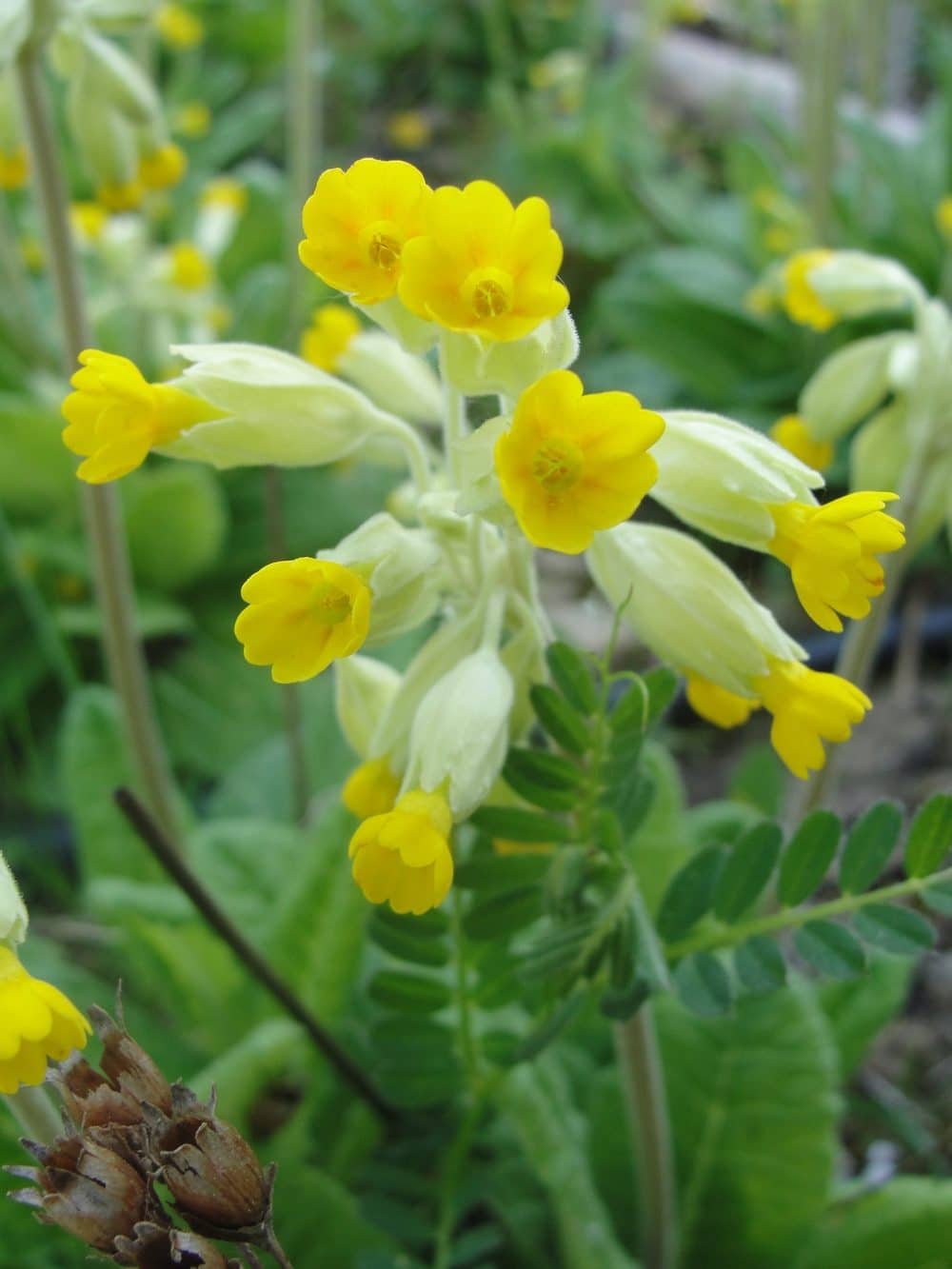
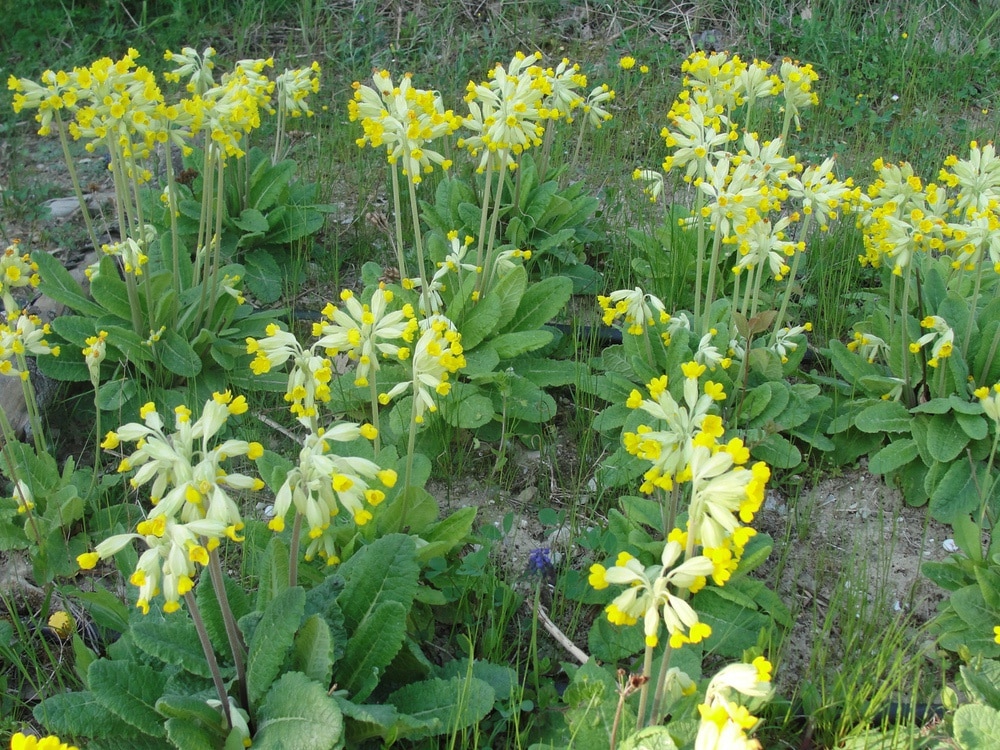
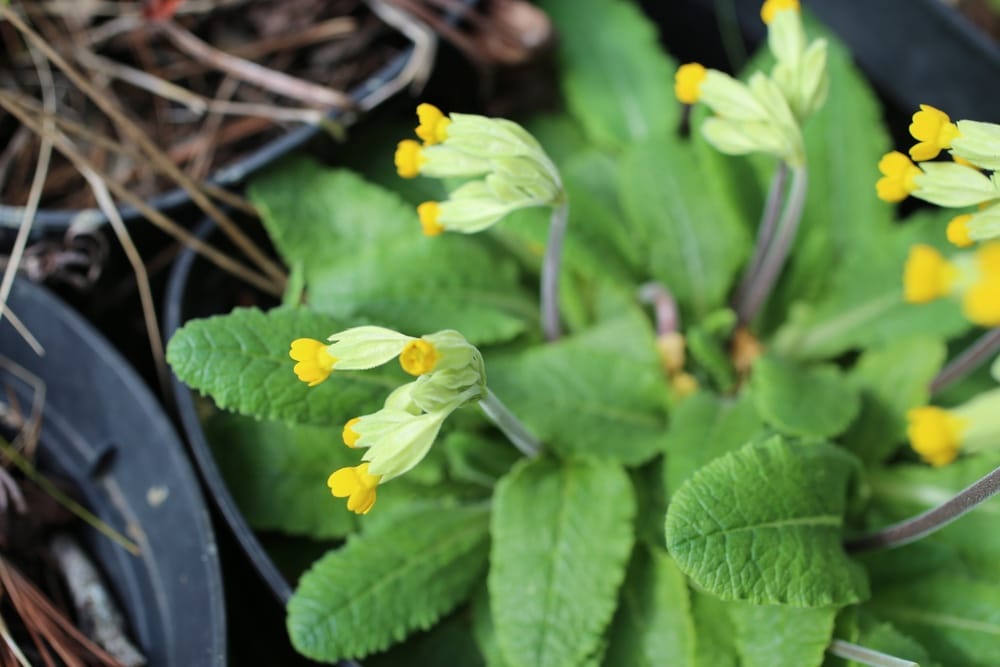
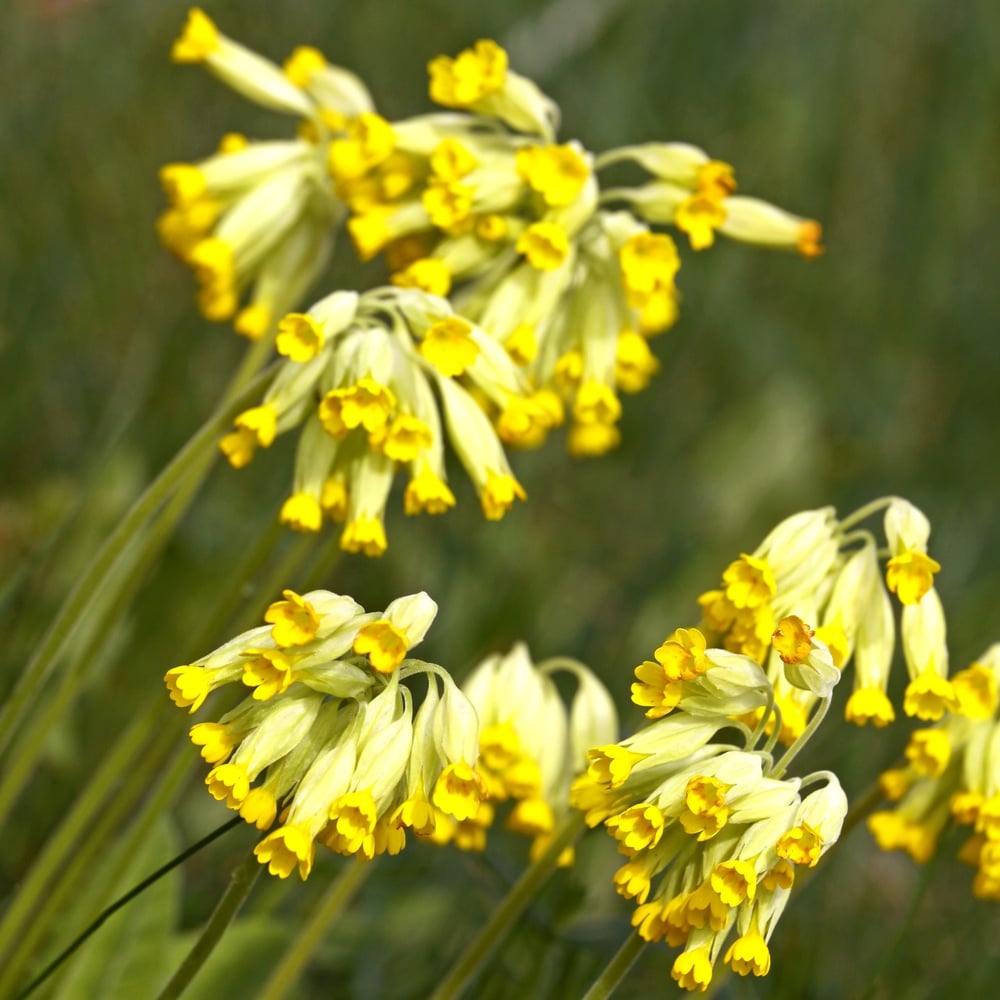
You won’t see it during the winter; it goes dormant. But toward the end of winter, you’ll see a rosette of leaves appear. They are light green. They have that crinkled look to them, and they lie flat on the ground. Then a stem will come up from the center of the rosette and produce a cluster of flowers all attached at the same point. The yellow petals are fused, and you will see 5 orange spots on the petals, arranged all around the flower. It’s really beatiful.
The calyx is tube-shaped, so that’s the green part of the flower. And to put it in non-botanical terms, the flower looks like a little yellow trumpet speckled with orange sitting inside a green tube.
Marie-Antoinette Mulot, a famous herbalist of the past, tells us that we go pick cowslips just like we go pick daffodils, and by doing so, we bring a bit of spring into our homes.
Where does it grow?
So where exactly do we go to pick cowslip? In meadows, pastures, along paths, in forest clearings from the lowlands up to the mountains. It’s not very common where I live in Provence, it’s way too hot, but I do manage to find some. I have to go looking in cool and shaded spots because it doesn’t handle hot and dry very well.
I have also grown it in the garden for many years. I keep it in a shaded area and I water it on a regular basis.
Parts used
The parts used are the flowers and the roots. These two are different remedies. More on that in a few minutes.
Constituents and Energetics
- Flowers:
- Saponins (particularly in the sepals)
- Flavonoids: rutinoside, quercetin, luteolin, kaempferol, etc.
- Condensed tannins: epicatechin, epigallocatechin, proanthocyanidin
- Carotenoids
- Essential oil
- Roots:
- Triterpenic saponins
- Phenolic heterosides
- Tannins (traces)
- Sugars
Energetics :
- The flowers are cooling and drying
- The roots are warming and drying
Properties and indications
Alright, let’s move on to properties and indications. And to do so, we need to do a bit of historical background.
Historical background
When it comes to the use of cowslip in the old herbals, we don’t find much in the ancient civilizations. I had been told this is probably because it doesn’t grow in Greece or Italy, so obviously we are not going to find much in the old Greek and Roman writings, which are the basis of European practice. But actually, as Fournier explains, the common primrose does grow in those countries. So why no mention at all? We’re not really sure.
A little later, it is mentioned in medieval writings. Hildegard of Bingen talks about it for melancholy, and here we should understand a certain state of sadness. She also mentions it for much more serious situations, like apoplexy (an old medical term for a stroke) or paralysis. In fact, it used to be called “palsywort”.
On the French side, it gets a good kick in the pants in the 1800s with Cazin, one of our famous countryside doctors, who figures the plant could disappear from our herbal knowledge and nobody would miss it! I’m guessing he tried it without success.
And then finally, in the 1900s, we see a very clear renewal of interest in certain hospitals and from certain doctors, for anything lung-related, and we’ll come back to that very soon. It’s not a well-known medicinal plant today and that’s a real shame, because it’s very present in our ecosystems, and it’s very useful for all the winter complaints that hit the bronchial tubes.
Cowslip flowers for the nervous system
But before we talk about bronchial tubes, let’s talk about the nervous system. The flowers are useful here, not the roots. The flowers will gently work to calm down the nervous system.
On the English side, here’s what Maud Grieve tells us about cowslip flowers. Maud Grieve, if you don’t know her, is a woman who did some admirable work in the early 1900s. She wrote a book called “A Modern Herbal.” And let me tell you, for the early 1900s, that was definitely modern. And above all, it’s a remarkable encyclopedic work on plants.
On the subject of cowslip, Grieve tells us that in olden times it was a much-appreciated remedy for strengthening the nervous and cerebral functions, and for relieving restlessness and insomnia. So what does all that mean? Why would we go and strengthen the nervous functions when we’re already stressed, for example? Aren’t we going to make things worse?
Well, no, not at all. What we need to understand here is that when we’ve pulled on the rope a little too hard, when we’ve been stressed for a certain period of time, at some point the nervous system takes the hit. Physically, you can feel very tired, and emotionally, you can feel very fragile. It’s as if all of a sudden the nervous system doesn’t have enough resources left to cope. That’s when “strengthening the nervous functions” ise useful. To give the nervous system a certain energy again, but a more stable one this time.
You can also picture the different phases of stress. Before exhaustion, there is overexcitation. It has a calming, anxiolytic, sedative effect in phases of acute stress. You can combine cowslip flowers to orange blossom flowers, hawthorn flowers, linden flowers, german chamomille flowers. You could make a beautiful tea blend with flowers only, one that brings a very gentle, very floral cooling energy.
Headaches and migraines
Maud Grieve talks about cowslip for headaches too, and puts it on the same level as wood betony from that point of view. And in fact, that’s a use we find on the French side as well, with an indication for migraines of nervous origin. In that situation, we could combine cowslip flowers and betony flowering tops.
You’ll see cowslip flowers in blends meant to help with restless sleep. Here again with other plants that have a mildly sedative action. Sweet woodruff, linden flowers again. Birdsfoot trefoil (we talked about that plant in a past episode).
Lung infections
Alright, now that we’ve had a good overview of using the flowers, let’s talk about the root. The first time I harvested the roots, I was really surprised by how aromatic they are.
The roots have a particular affinity for the bronchial tubes. We’re going to make a tincture out of them, that will be the best extraction for the aromatics. I recommend using fresh roots if you have high-proof alcohol. You can also make a tincture from recently dried roots. Or make a decoction of the roots, water extraction will be a little less effective, but it will work.
The effect will be expectorant. And it’s an action that seems to happen through substances we call saponins. “Saponin” makes you think of soap, and that’s intentional, because these are substances that make water foam. We find saponins in soapwort, which is well known for its surfactant properties. The thinking is that saponins — which are irritating to the digestive system — will also go and irritate the respiratory tract.
And the thinking is that this irritation gets communicated from the stomach to the lungs. These two organs are connected by the same nerve, the vagus nerve, which used to be called the pneumogastric nerve, a name that had the advantage of reminding us that the lungs and the digestive tract are connected by the same nerve. So picture those saponins irritating the stomach; that irritation gets communicated by the nervous system to the lungs, which receive that irritation signal and wake up. It’s like a little kick when you’re a bit tired. It wakes you up. The result: expectoration. Something that’s very welcome at the end of an infection (like a bronchitis) when the person no longer has the strength to bring up that waste, so there’s stagnation, and that’s not good at all.
You can also use that effect during the peak of the lung infection, to help the lungs clear up waste. More useful toward the end in a healthy person, but also useful in the middle. In the person with weak lungs or immunity, better to start right away with the herbal expectorant.
External application
We can also use cowslip root externally, as a decoction. In the French tradition, we see it used for contusions and bruises.
People also used to prepare an oil infusion with the flowers, and used it for skin inflammations, small scrapes, and burns.
Forms and quantities
Let’s talk forms and quantities. Here are some instructions from Dr. Valnet, a great practitioner from the 1960s to the 1980s:
- A tea of the cut aerial parts (meaning leaves, stems, and flowers), or a tea of just the flowers (which I like much better): 1 dessert spoon per cup, steep 10 minutes, one cup after meals.
- Decoction of the root: 1 dessert spoon per cup, boil 2 minutes, steep 10 minutes, 3 cups a day between meals. Dr. Leclerc, another great practitioner, recommends 5 to 6 g of the crushed roots for a 200 ml cup of water (that’s about 7 oz of water).
These quantities are given for when you use the plant alone. If you use it in tea or tincture blends, the dosage would be different and would need to be adapted to the blend.
Precautions
In terms of precautions:
- There can be allergies to the plant. French references mention that allergies are rare with the native species but more frequent with the garden varieties.
- The roots can be irritating to the digestive tract, as I explained (since it is rich in saponins), and can cause nausea and diarrhea if you take too much or if you have a very sensitive digestive tract.
And that’s everything I have to tell you about cowslip. I hope you’ll run into it at the bend of a path, in the cool of the understory. And maybe at that moment, the plant will offer you a few of her pretty little flowers. Don’t forget to send her your gratitude.
Thanks for being here, I will see you soon for the next episode of TheFrenchHerbal.