
Hey there, Christophe from TheFrenchHerbal.
I love linden. The smell of linden flowers takes me right back to my childhood. Back then, I used to spend my weekends at a great-aunt’s place in a tiny village in Provence. We would harvest the linden in July, and we didn’t need to go very far. The village had some very old trees. And we would spread the flowers on big sheets to dry. The scent would take over the whole tiny village house that she had, and you could anticipate all the fragrant herbal teas that were coming in the winter months.
Linden tea is probably in the top 3 of the most beloved herbal teas in France. Many kids of my generation had to drink some at one moment or another because… someone would shout, “won’t you just stop moving around and calm down a bit, it’s almost bedtime, for God’s sake!”. Yeah, that would be my gramma…
So, it’s a real pleasure to take you on a little tour of one of the gentlest plants in our herbal toolkit. When I use the term “linden” in this episode, I’m talking about the flowers. Another time, I will tell you about linden inner bark, which is another much appreciated herbal remedy here in France. All in due time.
Before we start, a quick but important reminder: I am not a doctor, pharmacist, or licensed healthcare professional. The information shared in this episode is for educational and informational purposes only. It is not intended to diagnose, treat, or cure any condition, and it does not replace professional medical care. Always consult with your physician before starting any new herbal protocol, especially if you are pregnant, nursing, or taking medication.
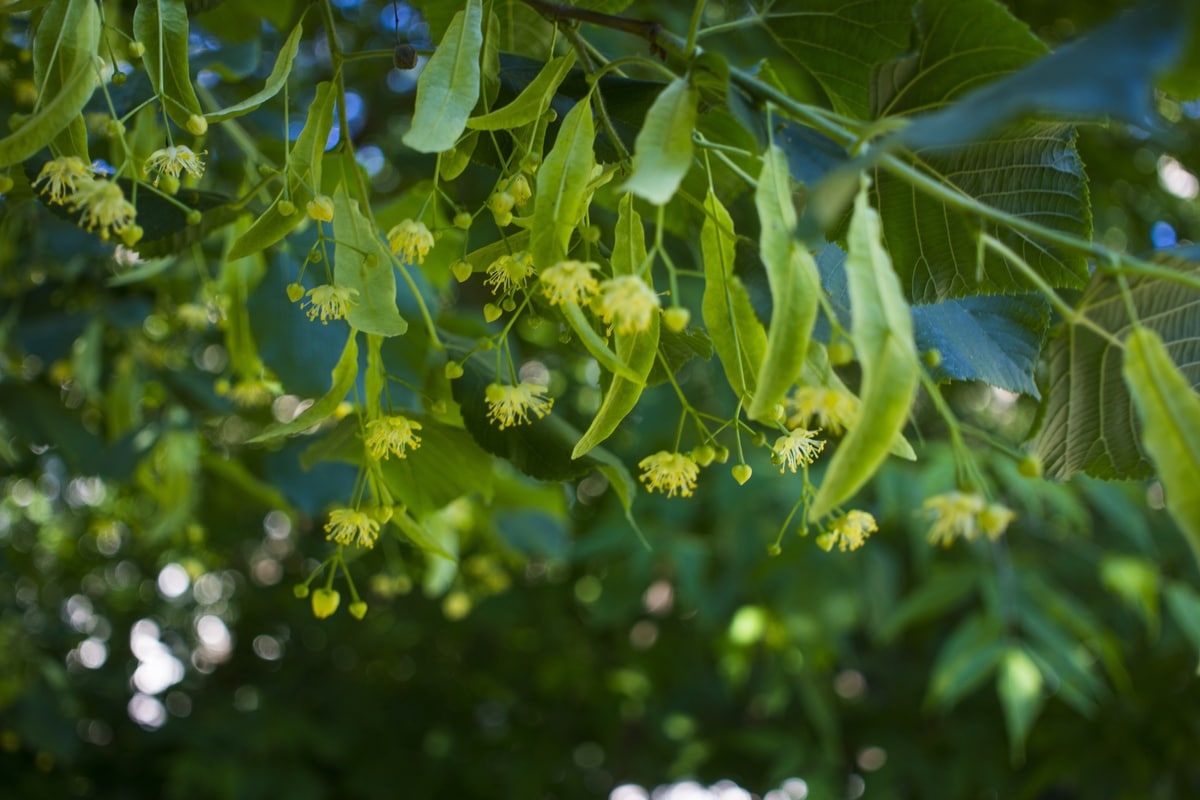
Let’s start with a bit of botanical information. Linden is a tree that belongs to the Malvaceae family. Yep, same family as common mallow and marshmallow. That tells us a thing or two regarding constituents and properties. Yes, it will contain mucilages, and it will be demulcent.
Linden is a super common tree in France, found in village squares and along the roadsides.
Different types of linden are used for harvesting: the large-leaved linden (Tilia platyphyllos), the small-leaved linden (Tilia cordata), and the common linden, which is a hybrid (Tilia × europaea). In the US, you have American basswood (T. americana). Silver linden (Tilia tomentosa) is sometimes used.
The one you’ll usually see at lower altitudes in France is the small-leaved variety. Higher up, you’ll generally find the large-leaved one. The one you spot in gardens, parks, or village squares is often the hybrid variety: a mix of the large and small-leaved types.
They’re all good to pick. Some people even say the hybrid smells better than the others. If it looks like linden flowers and has the sweet, honey-like scent of linden flowers, it’s probably good to go in your cup. However, please make sure you are picking the right species. Because in my years of practice, sometimes, I’ve been unpleasantly surprised by the mistakes and confusion people make. They think they are picking a certain herb, and they are picking another, and as you know, the mistake can be fatal. For linden, though, the risk of confusion is relatively small.
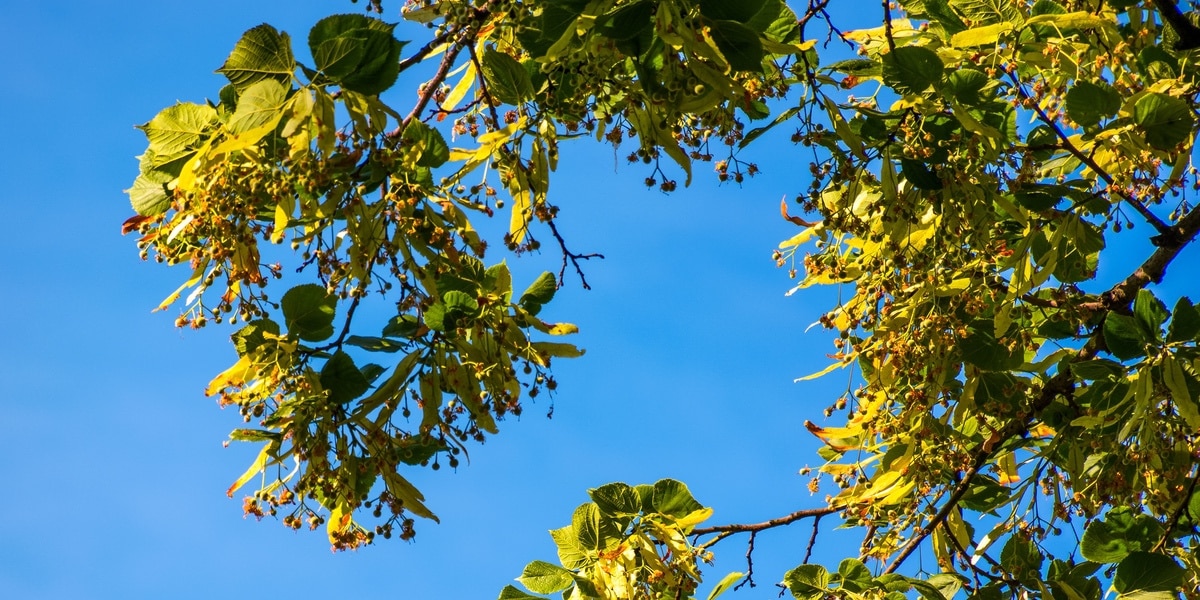
Linden trees grow slowly, and they can live a very long time. You can find some that are over 1,000 years old. In some French villages, we still have what are called “Sully’s lindens.” Sully was Henry IV’s minister, and he had them planted back in 1598. So, those trees are at least 400 years old.
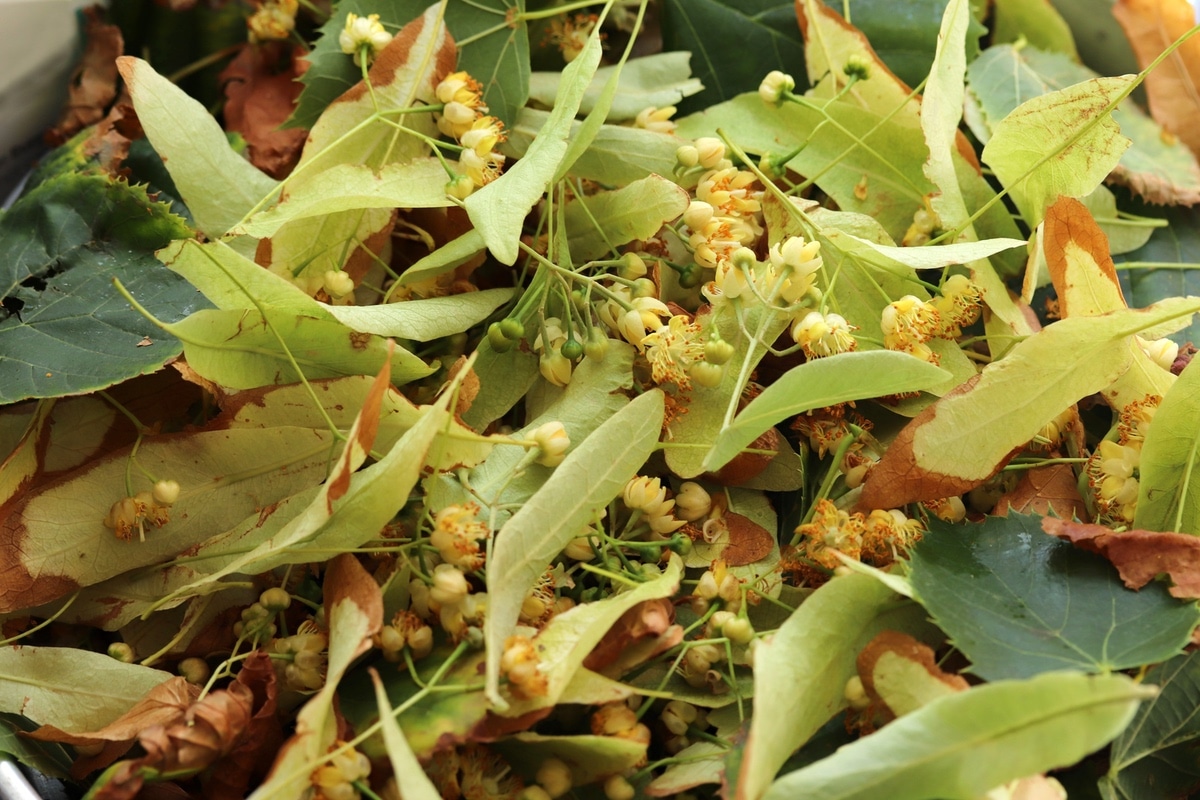
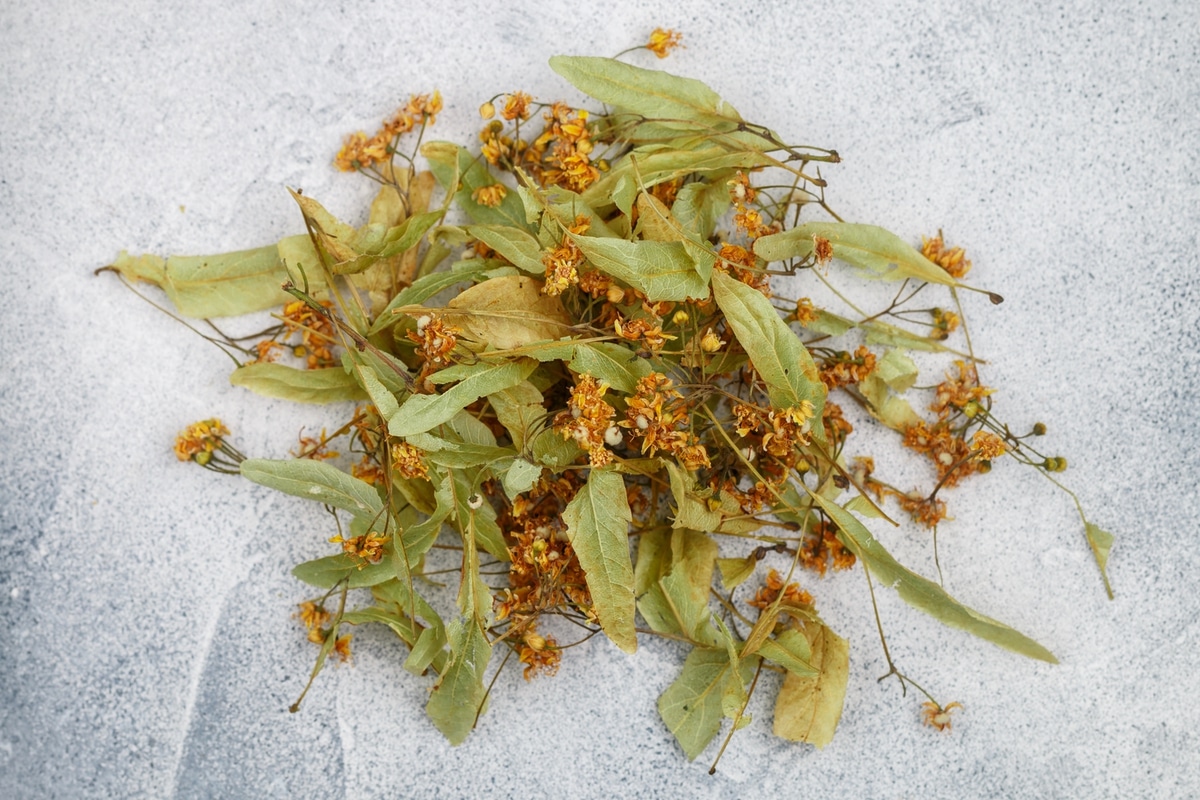
The parts used are the flowers with the bracts. So it looks like a leaf, with a stem and a few flowers attached. That is, if you pick it and dry it yourself. If you buy from a store, chances are, it will be crushed, so you won’t recognize what I’m describing here. If you use just the flowers, without the bracts, the tea will be even more aromatic. And some pickers do this; they remove the bracts. This is quite uncommon, though, and you won’t find just the tiny flowers from your favorite herb store. Flowers plus the bracts—that is pretty standard and good enough. From now on, I will just use the term “flowers”.
The ideal time for picking is when most of the flowers are fully open (some of them will be closed, and that’s fine). The ideal flowering period will last for just a few days, and at that moment the smell will be almost intoxicating for the most aromatic of trees.
Older generations only picked the most aromatic of lindens that could keep their aroma when dried, which depended on species (for instance, the hybrid Tilia × europaea was known to be more unstable and less predictable than other species).
For drying, spread the flowers on drying racks in a dry, well-ventilated room out of direct sunlight. They should be dry in 3 to 4 days, usually. Then you store them in paper bags, away from moisture. They’ll stay fragrant for several months if you keep them right.
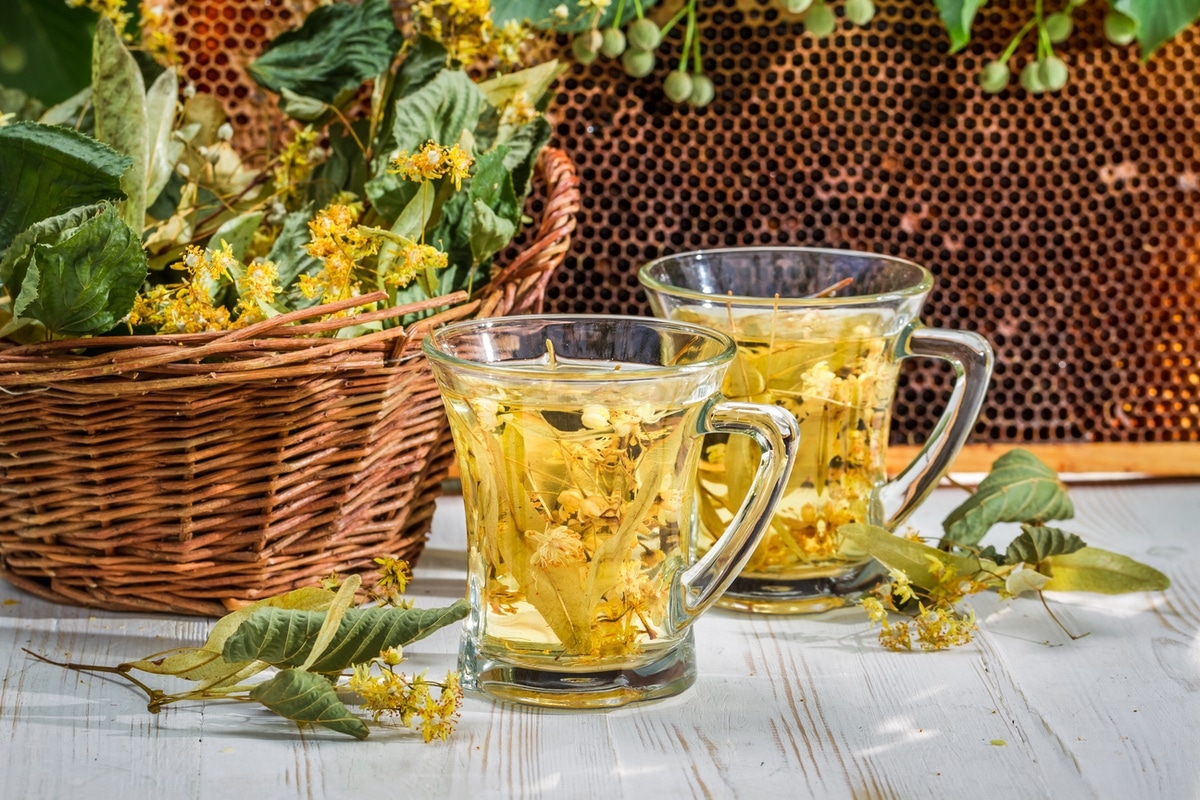
In terms of constituents, we have :
The energetics: cooling and moistening. Linden flowers make a sweet-tasting, demulcent, very pleasant tea.
Let’s talk about properties and indications.
First of all, linden calms down hot tempers, what we may call hyper-excitability in both kids and adults. You know, that state where someone can’t sit still, constantly moving, jumping up from the table, fidgeting, etc. Basically, if you have kids, you know exactly what I’m talking about. It’s a state of nervous tension—very “electric.”
Some adults get this way too, sometimes when they’re overloaded with ideas and projects. Sometimes, we call this “positive stress”—the kind of stress that comes with a lot of motor energy, making it hard to wait until tomorrow to get started on something. Entrepreneurs often deal with this “brain-on-fire” state. Sure, it’s positive stress, but it’s just as disruptive—too much adrenaline, too much cortisol at the wrong moment of the day, restless sleep, and all the metabolic mess that comes with it.
So, we’re really talking about a state of nervous excess here, usually accompanied by heat (in the sense of movement, agitation… you know, technically, heat is generated by molecular agitation). So, don’t confuse this with nervous exhaustion, which is more of a “crash”, an empty state—feeling depressed or having no drive (a lack of nervous tone, the opposite of the tension we’re discussing here). Although linden also feels kind of nourishing to the nervous system, I think it’s due to this sweet, reassuring effect that wraps you up in a comfortable blanket.
Let me quote François-Joseph Cazin, one of our great herbal docs of the 1800s.
“Linden always produces a sense of well-being resulting from the sedation of the nervous system“.
Sedation: the reduction of agitation.
Sometimes the person suffers from heart palpitations due to the excitement, and as we’ll see later, linden is great for the cardiovascular system because it “cools it down.”
For all these situations, you can drink linden tea twice a day and use this as an excuse to chill out. There’s nothing wrong with sitting down for 10 minutes and flipping through a good book. If you can’t remember the last time you allowed yourself such a “luxury” (and I plead guilty here) then linden is definitely for you! And if the boss sees you in the break room with a teapot full of linden and gives you the stare, guess who needs a cup?
For kids, try a tea at the end of the day, after their shower or bath, to start getting them ready for bed—just not too close to bedtime to avoid any middle-of-the-night bathroom accidents. A little honey goes a long way here to make the tea even sweeter.
There is a beautiful, almost poetic quote from Henri Leclerc, an amazing practitioner of the 1900s. I am going to rephrase it in a more modern form. He says:
Whether it’s the high-powered woman whose frantic lifestyle leaves her feeling anxious and frayed, or the worker who has a demanding physical job and returns home exhausted and aching from a long day, or the student whose late-night study sessions lead to chronic headaches—everyone finds comfort in this fragrant tea. It is appreciated not only for its elegant aroma and delicate taste but also for its remarkable power to restore balance.
I will put the original quote on my website (translated by yours truly), just for the poetic language of Leclerc.
“For the high society woman whose noisy, hollow existence grinds her nerves with neuroses; for the man of the fields who returns, in the evening, bent by hard labor, to his smoke-darkened cottage; for the scholar whose prolonged vigils have crowned his brow with migraine—each turns to the fragrant infusion, sought for its graceful aroma, its delicate flavor, and its tempering virtues..”
So you see, linden isn’t just for kids; it works for adults too, no matter your job or social status—linden isn’t picky; it adapts.
When it comes to mixing it with other plants, it goes great with orange blossom: a pinch of linden and 3 or 4 orange blossoms in a cup make for a fabulous tea. It also pairs well with hawthorn flowering tops—keeping things floral and gentle. Or maybe a bit of rose petals.
Jean Valnet, another one of our renowned French docs, recommends using linden flowers in a bath for children’s convulsions or nervous exhaustion—a relaxing soak, if you will. Usually, you brew a strong infusion in a big pot using 2 or 3 handfuls of linden flowers, then pour it into the bathwater.
Very important side note: I don’t know if you knew this, but for a small number of people, linden can actually be stimulating. Some suggest that a very short infusion time, say a couple of minutes, no more, will solve the problem, and that the longer it steeps, the more it excites. Personally, I’d just say if linden revs you up, it’s not for you—there are plenty of other plants that can help you relax. Although for most people, linden should indeed be calming.
Alright, let’s talk about fever now. We mentioned the “heat” state earlier. Turns out, linden is an excellent diaphoretic, right up there with two other herbs I highly value: elderflower (Sambucus nigra) and yarrow (Achillea millefolium).
A diaphoretic plant helps the pores of the skin open up so you can sweat more easily. Releasing fluid is a way to release heat. Sweating is necessary for that “radiator effect.” So, linden is a great plant to support a fever and help the body regulate its temperature. In this case, the tea should be drunk hot and at regular intervals throughout the day.
Rudolf Weiss, a famous German herbalist, explains that even if the person doesn’t sweat, linden will still bring a general boost to the immune system (ref: Weiss).
Let’s now move on to cardiovascular health.
Linden is traditionally used to help with high blood pressure when it’s linked to nervous tension. This is different from essential hypertension (often seen as a kidney regulation issue), which usually calls for diuretics. Here, we’re talking about blood pressure that fluctuates and spikes with stress. It will mix well with hawthorn again, with olive leaf, with passionflower leaf.
Linden has been used in French practice for atherosclerosis, the buildup of arterial plaque. Valnet says it works on the tendency of the blood to be hyperviscous and to coagulate a little too quickly. So the blood is thick and reactive, if you will (ref: Valnet). Basically, linden helps the blood flow more smoothly and lowers the risk of blockage.
I’ll let Leclerc have the final word again here:
“Through many clinical observations, backed by blood tests, I’ve concluded that linden is truly effective in arteriosclerosis for addressing what I call the ‘triple blood dyscrasia’ (high red blood cell count, high viscosity, high potential to coagulate)—making the blood more fluid, more ductile, and preventing it from pooling in the vessels or sticking to the walls.”
Let’s move on to the digestive tract.
Cazin gives us a little lesson here on using mucilaginous plants versus astringent ones for diarrhea. He says:
“I cannot help but point out that many chronic diarrheas, for which astringents are used to no avail, give way to the persistent use of mucilaginous plants: this is because these issues are often due to an irritation of the mucous membrane, which astringents don’t always fix.”
This is a very interesting point, since the beginning herbalist will usually grab an astringent herb for any kind of diarrhea. How about soothing that irritation with mucilage instead of astringing the mucous membranes?
Generally speaking, whenever there’s inflammation of the digestive mucosa (esophagus, stomach, intestinal tract), linden is a good call. It’s definitely not as thick and slimy as marshmallow root, but it’ll do the trick if you don’t have any marshmallow on hand (just use a strong infusion here).
In terms of preparations, the simplest form is what we call the “infusion” in France, which is a tea of the flowers.
You can also use the tincture of the fresh or dried flowers.
In terms of contraindications and precautions, not much to worry about, really. Except for the fact that, once in a while, as I explained, it ends up being exciting instead of calming. That’s the way it goes with plants; they are complex, they have a way to surprise us!
That’s it for linden. Gosh, it brings so many memories. To me, it’s my summers in this tiny village of Provence with my great-aunt and my grandparents. Just thinking of this, and I melt like marshmallow. So, the next time the world feels a little too “electric,” brew yourself a nice cup, take a deep breath, and let it work its magic.
Thanks for being here, I will see you soon for the next episode of TheFrenchHerbal.