
I am in the beautiful Swiss Alps, and you should see the yellow gentians flowering in the alpine meadows. So beautiful. Now, friends, we are talking about a big icon of French herbalism. Huge. Very long tradition of use over here. Big in size, at least for yellow gentian, which is a big plant, and big in health benefits. Unfortunately, gentian has been reduced to a mere appetite and digestive stimulant. And you will see that it’s a lot more.
It’s an exceptional plant when used properly. It keeps on giving when we are patient enough: small doses, long-term use. Stay with me, all the details are coming, because in this episode, I’d like to pay a tribute to that amazing lady of the Alps.

I will give you 3 major properties. Gentian can do a lot more, but I don’t want to send you in too many directions. So I will insist upon its biggest potential, in my view. Then we will talk about in what form and what quantities to take it. I will tell you how I have integrated gentian in my habits, thanks to one of my good friends who lives in the Alps and got this great preparation from the locals. And I will finish with a change of mind that I had about gentian. I just didn’t think it could work this way… but that will be toward the end of the episode.
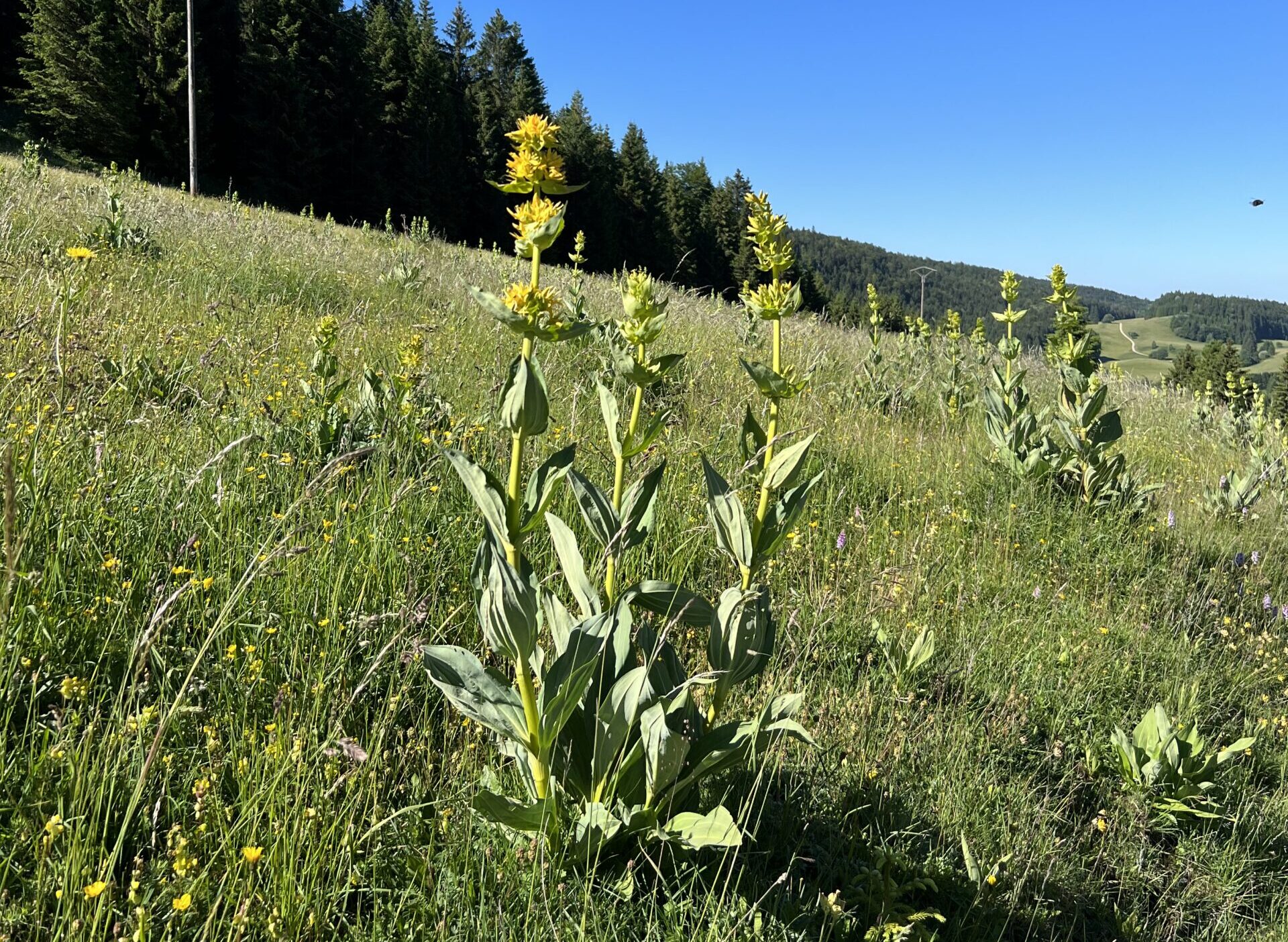
OK. Let’s start with the plant. It’s a perennial that belongs to the Gentianaceae family. In France, we mostly use Gentiana lutea, the yellow flower gentian. In some regions, we also use Gentiana purpurea, which has reddish-purple flowers, really beautiful. We also have blue gentians and other types of gentians. Now, please check your local flora to see which one is available around you, if any.
And also, very important, what can be picked, cause in France, in some regions, Gentian has the protected status. It is precious. It is overharvested in some regions unfortunately, we are seeing some of that in France unfortunately due to the demand from the liquor (“leaker”) industry. It can live more than 30 years, up to 50 years or more. So we have some very old plants that are producing seeds and contributing to the renewing of that precious resource.
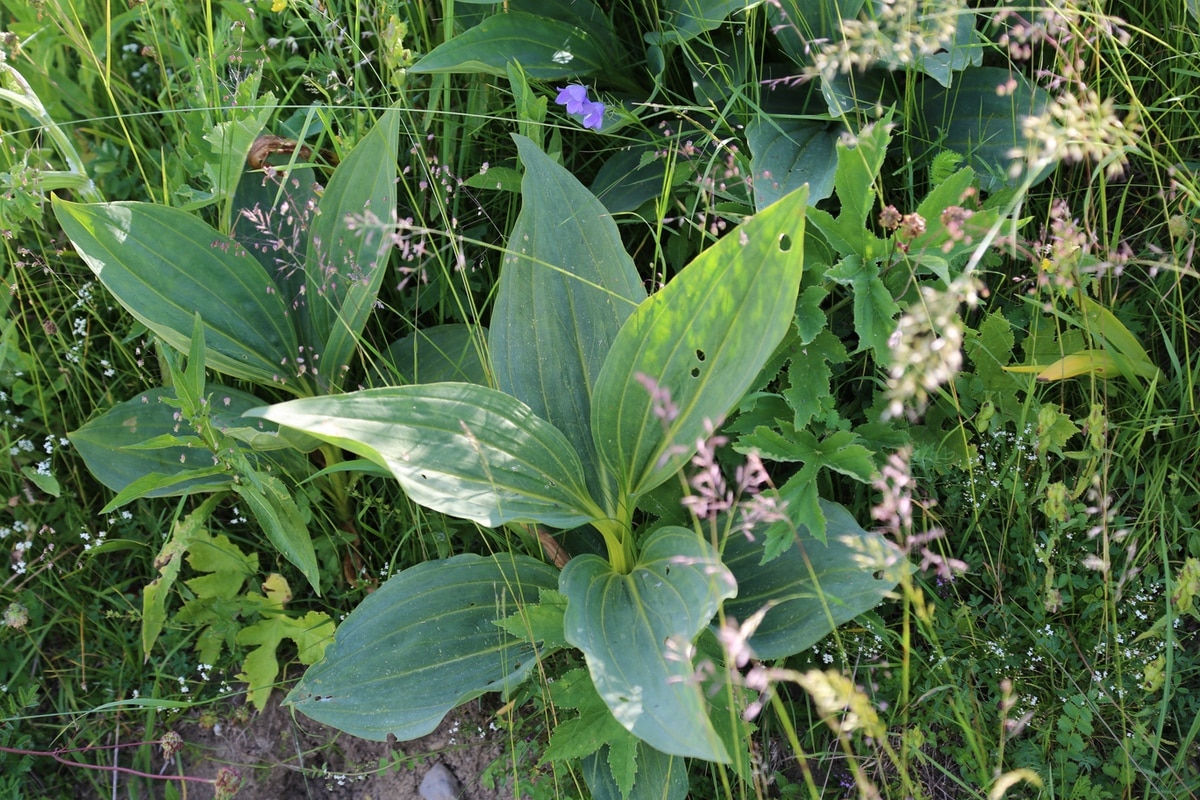
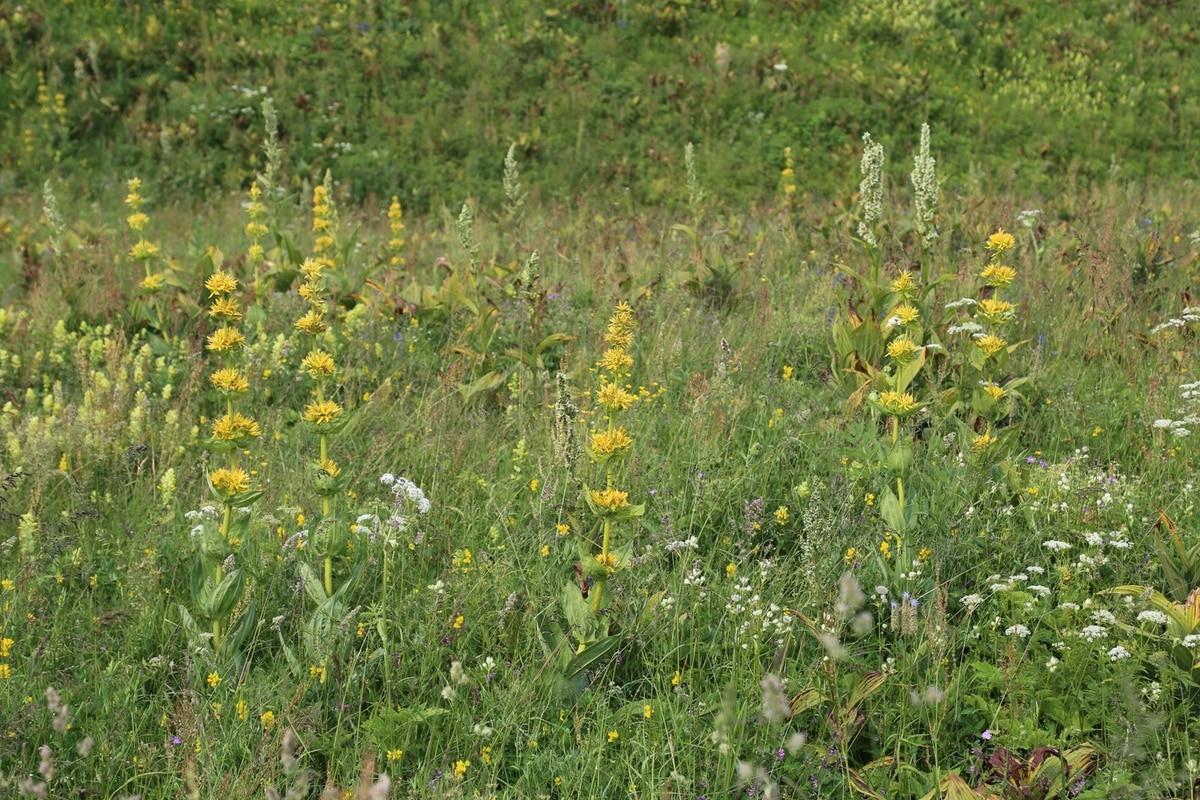
Also, keep in mind that in some meadows, yellow gentian will grow alongside Veratrum album, and can be confused with veratrum by the beginner. Be very careful cause veratrum is deadly, very toxic.
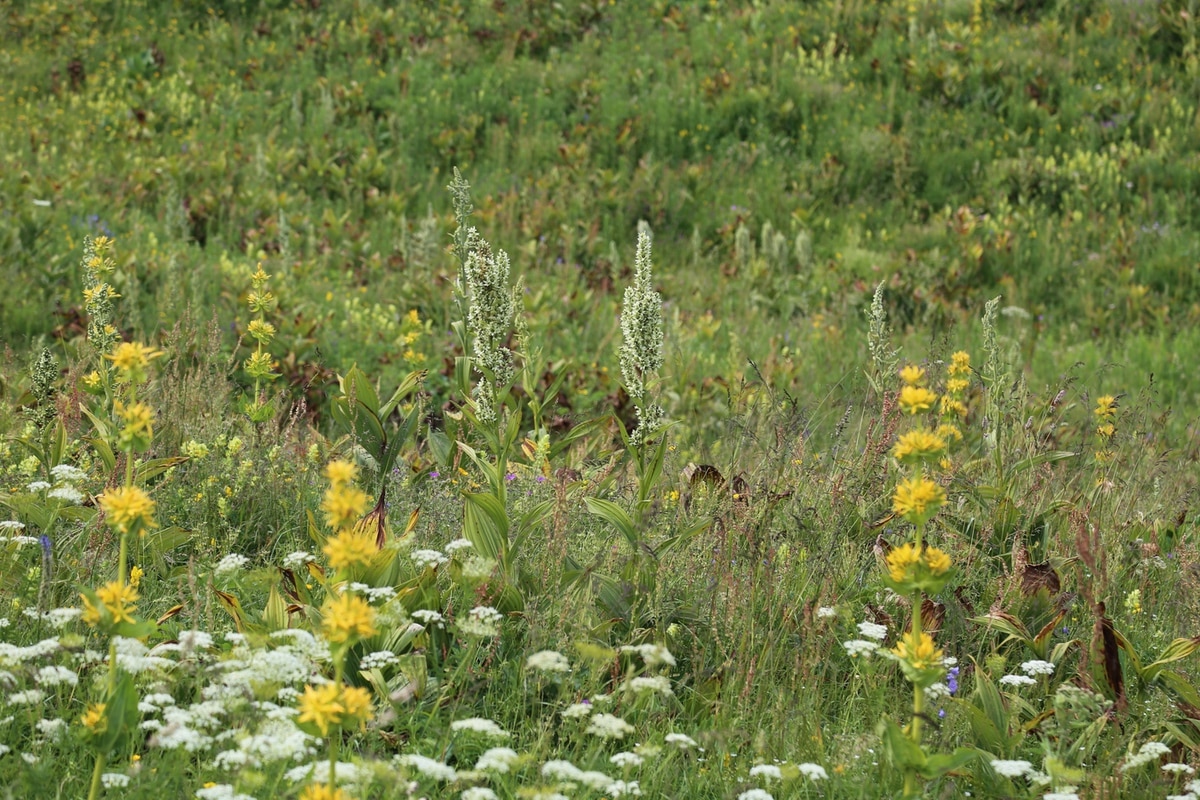
We are going to use the roots of gentian, and they are extremely bitter. We can play the game of which plant is the most bitter: is it andrographis, or bogbean or verbena or some others. Doesn’t matter because, my oh my, gentian is darn bitter. We will talk about preparations in a few minutes. First, the properties and indications.
I will start with a quote from a very well-known French herbal doctors who practiced in the beginning of the 1900’s. His name is Henri Leclerc. He said of Gentian: “An old doctor claimed, based on his own experience, that taking a small piece of the root each day was enough to reach a very old age in perfect health.”
Now, Leclerc was not to be fooled by baseless claims. He was a very serious and experienced practitioner. So why did he repeat that sentence in one of his reference books ?
Here is my take. Because gentian acts at the foundations of health, which is digestion and immunity. And it even goes beyond that, acting at the core of vitality.
But let’s start with digestion. And even before that, let’s start with the context.
Today, if you’re a practitioner or just a health afficionado, you have noticed that many people suffer from a wide range of digestive issues. Several factors contribute to this. First, a problematic diet, we know that. Also, a lifestyle marked by chronic stress, where we no longer take the time to eat mindfully. We work too much, we worry too much. And stress is one of the main inhibitors of digestive function. Stress slows down the whole digestive process. So you feel like you have a brick in your stomach when you eat under stress.
We also have a striking paradox today: we’ve never eaten so much in terms of quantity, in terms of calories. And yet we’ve never been so depleted, so starved in micronutrients! Vitamins and minerals. The return to health must therefore begin with re-nutrition, which requires both a serious reassessment of our dietary habits as you know, and a reactivation of our digestive functions. Ah, this is where gentian will shine.
Gentian is a digestive tonic. And at the root of its action, lies bitterness. We call those plants « bitter tonics ». And they are very precious in our practices. When a bitter substance gets in contact with our taste buds, a message is sent to the brain, then to all of our digestive organs. The message is simple: wake up! The bitter substance has to be tasted if we want the full effect. Now, the plant will also work if you take the powdered roots in capsules for instance, therefore bypassing the taste buds, because we have bitter receptors all over the digestive tract. But not as well. You need to taste the bitterness if you want to take advantage of its full power.
From the mouth, bitterness triggers salivation. Let’s not forget that digestion starts in the mouth, and abundant saliva is essential for this phase. Bitterness promotes the production of digestive juices: hydrochloric acid and pepsin in the stomach, digestive enzymes from the pancreas, and the intestinal lining. Bile from the liver and gallbladder, bile being so important to emulsify fats before we can digest them.
Bitterness enhances the contraction of the smooth muscle that lines the digestive tract. So it stimulates both the chemical and mechanical digestive processes.
And frankly, few plants act so effectively across all these pathways.
In the past, gentian was traditionally used in France after long convalescence, when the person was exhausted and had little appetite. Even if hunger returned, the digestive system had not yet recovered from illness. So the person had trouble digesting complex foods. Gentian came to the rescue, boosting appetite and digestive capacities, so that the sick person could recover faster.
Today, I use it often whenever there is digestive deficiency, which can show up in the form of stagnation of food, fermentation, bloating, acid reflux due to stomach stagnation. It is the base of my protocol, usually in the form of a tincture before meals. And that is a very important point, it needs to be taken before means. And I will often add a tea blend to drink in small quantity after the meal to help with cramps and bloating. The combination of gentian tincture before meals and a concentrated digestive tea upon digestion is usually a very good start to get relief. In the tea, many choices, from fennel or anise seeds, to peppermint, rosemary, a bit of licorice if there is inflammation and if not contraindicated, etc.
Gentian can be taken, and often should be taken during several months for chronic long standing digestive conditions. Small doses, 20 to 30 drops of the tincture in a small quantity of water. 10 minutes before each meal. And then, the digestive tract will gradually regain its capacities, its fire, and the person can shift into a re-nutrition mode, if the food is nourishing of course. Very good combination with angelica or ginger or both. You could take a blend of 20 drops gentian root tincture, 20 drops ginger root tincture, and 10 drops angelica tincture for instance. That’s a nice blend. Ginger will improve gastric emptying, angelica will act as an overall digestive tonic. We’ll talk about those plants in future episodes.
Now, something people don’t usually associate with gentian: the nervous system.
Quite interesting. Here is how I see it. Gentian is a major parasympathetic stimulant. It brings us back to our guts. And you probably know this dance, this equilibrium between the sympathetic and parasympathetic nervous systems. If one dominates (and today, most of the time, it’s the flight or flight response, so the sympathetic nervous system usually dominates), when that happens, you can either calm the one that is excessive, or stimulate the one that is deficient.
Today, most of the time, we are into sympathetic excess and parasympathetic deficiency. To calm the sympathetic excess, to lower this overactive stress response, you can either push that one down via relaxing and calming herbs, or something that is less known and less used, you can stimulate the rest and digest response, which is the parasympathetic nervous system. So here, with gentian, we will bring the energy back to the guts, we will stimulate the parasympathetic, therefore indirectly calming sympathetic excess. I don’t know if you managed to follow my reasoning, but what I am saying, is that by bringing us back down into the gut, gentian gets us out of our heads a bit, from the place where there is too much rambling about the past and doom-prediction about the future. So gentian is kind of cooling to the nervous system.
Bitterness. Back to the guts. Back to earth.
Another interesting point, kind of related. Over here in France, gentian is sometimes positioned as an antidepressant. Some studies show that gentian acts as a monoamine oxidase inhibitor, which may promote higher serotonin levels in the brain environment. This action would be similar to that of certain antidepressant medications. This is oversimplistic; as we know, depression is not simply a matter of low serotonin levels. Agreed. But that action, coupled with the “bringing us back to our guts,” could be interesting in the context of mild to moderate depression with low appetite and digestive stagnation.
Another interesting point is the fact that gentian, in the digestive-deficient person, will help to better extract certain amino acids, like tryptophan, that are essentials to make serotonin and melatonin. And this requires strong gastric and pancreatic activity.
Overall, I would say that today, we are just starting to understand this amazing dance between the central nervous system and the enteric nervous system. The two are in constant communication. When the enteric system is underfunctioning or impaired or suffering, the central nervous system will inevitably be affected. So gentian could help here.
Finally, let’s talk immunity — and this may surprise you. This property is not really known to the general public. Let’s go back to our good Doctor Leclerc, who wrote that gentian is “capable of supporting the body’s defenses by increasing the number of white blood cells; it is therefore indicated in all cases of physiological weakness, debility following prolonged illness, in convalescent and anemic individuals.”
When you think about it, it is not that surprising. 70 to 80% of the immune system is located around the guts. This is what we call the Gut-Associated Lymphoïd Tissues, known as GALT. You see, I believe gentian could calm the immune provocation caused by poorly digested proteins and peptides passing through a chronically inflamed intestinal mucosa. So gentian may give a much-needed relief to an overstimulated gut immune system due to poor protein digestion and intestinal hyperpermeability (hai-per-per-mee-uh-BI-luh-tee). Undigested proteins are not supposed to end-up in portal cicrulation. The immune system will constantly react to that «intruder». Isn’t that interesting?
I do not have enough data to confirm this immune property in my practice, because probably, just like you, I will reach for my echinacea, black elder, astragalus or reishi for low immunity. So, as practitioners, be it in a family or professional context, I think it would be really interesting to observe and see if we can confirm that effect. If the person who is taking gentian for digestive deficiencies also has a low immunity, is she seeing progress on both fronts ?
Now, how do you take gentian ? In the old days, in France, the decoction of the roots was used. And holy cow, forget about it. I love my bitters, but sorry, no. You can try though, if you are curious. Doctor Jean Valnet, another one of our famous French herbal doctors, recommended 30 g (so about 1 ounce) of the dried roots, cut in small pieces, left overnight to infuse in 1 liter of water (so about a quart). Valnet said to boil it for 2 minutes, then let it sit covered overnight. 1 small cup of this brew before each meal. Hey, if you are a bit adventurous, give it a shot. But again… no.
My favorite form, the one I recommend the most to my clients in my private practice, is a tincture of the roots. You can tincture the fresh roots if you have strong alcohol or the dried roots with 40 to 50% pure alcohol, the rest water. About 20 to 30 drops in a bit of cold water. Take it in small sips, swish it around the mouth to feel the bitterness, and swallow. Ideally 10 minutes before meals. As said before, I may combine it with ginger, angelica, or other plants as needed. But gentian alone will do the job.
No sugar. No lemon juice. Nothing to cut the bitterness. Here in France, we want the person to fully feel the bitterness. Can you take gentian in a bitter cordial or other type of social drink with friends? Sure, let’s have a bit of fun too. But not bitter enough. If you want « gentian as a medicinal plant », you have to go for the full bitterness.
If there is a long-standing chronic digestive deficiency, gentian can be taken for months. As needed. Until the person feels better. Yes you can balance the energetics if you practice in that model, gentian being very bitter, therefore very cold, and requiring some warmth in the long run, ginger being perfect in my view. Or orange peel. Or an aromatic plant like rosemary.
Gentian capsules or tablets can be used. It will still work. Not as well as the forms forcing you to fully taste bitterness in your mouth. But it will work too, so let us not throw that option into the trash. Yes, it’s a shame, but when you work with people with certain types of constraints, sometimes you have to make compromises.
OK, how do I take gentian ?
Well, I prepare « gentian water ». I got this from my good friend Guillaume. So Guillaume, if you listen to this, man, you are now visible in the anglo-world. So Guillaume, who lives in the Alps, the mecca of Gentian, went to find some old folks doing hard manual labor when they were young. They said that when they felt weak, or when they had a drinking party the forthcoming night, they would put a few small chunks of dried gentian roots, about 2 or 3 chunks, in a liter of cold water, let it sit overnight, and drink during the day.
I have done this preparation many times now. I have started to recommend it to some clients as well. The feedback is positive. Me, with my past of overexcited and hot tempered guy, I need my bitters. It does me good. I use 3 chunks of dried gentian root. I put it in my bottle. I pour 1 liter of cold water, let it sit overnight. I drink it the next day, throughout the day. It has to be bitter but drinkable. If too bitter, start with 2 or even 1 chunk. Go slow.
Then in the evening, I will pour another liter on the same roots. Drink it the next day, it is still bitter. Then I will do it one more time with the same roots. So 3 chunks will last 3 days, one liter per day. I may do this for a few weeks. I love it. For my digestion, for my nervous system, for my overall vitality.
Note of caution : if you don’t want to let the same chunks of root in water for 3 days (risk of bacterial development ? Maybe…) then rinse your bottle every night and add 3 new chunks, just to be sure.
Now, the usual contraindications and precautions.
Gentian is contraindicated if you have active gastric or duodenal ulcers. Because it will stimulate gastric acid and pepsin production, and if the mucosa is ulcerated, not a good idea. Heal the mucosa first, with calendula, chamomille, licorice, etc. Then use gentian to prevent reoccurence. To strengthen the stomach, to have good acidity, and prevent the infamous Helicobacter bacteria from settling in.
We have no data for gentian pregnancy, so we don’t know if it is safe. Therefore, contraindicated due to insufficient data.
In breastfeeding, same, not enough data, plus the fact that the bitter constituents will pass into breast milk, which will alter the taste of milk and may disrupt breastfeeding. You can imagine the baby making the well known « bitter face ».
In terms of Side Effects:
In rare cases, bloating, loose stools, stomach cramps, nausea, and headaches have been reported. Most of the time, if used wisely, gentian will help solve those problems. But once in a while, it may trigger those issues in the sensitive person.
OK, now, my big change of mind. Gentian is a bitter tonic. It stimulates digestion and assimilation of nutrients. We talked about that. It has a strong reputation here in France as a general tonic when you are tired and your vitality is down in the drain. And you see, I thought it worked mostly through better nutrition. I thought « this is mostly a digestive plant ». A great one, one of the best we have for sure. But it brings back vitality via better assimilation of nutrients.
Well, I changed my mind on that. I now believe it is indeed a general, nonspecific tonic, working I don’t know how exactly, but with a direct effect on vitality as well. Even if you digest perfectly well. If you are run down and tired, you may want to add gentian to your core protocol. With other plants, sure, it plays well with adaptogens. But don’t forget that tall, beautiful lady of the Alps.
Thanks for listening. I will see you soon for the next episode of The French Herbal !
What is gentian root good for?
Gentian root is good for the digestion. As a tonic, it will bring energy back to a deficient digestive system suffering from stagnation, bloating, gas and reflux.
How much gentian tincture should I take?
A little goes a long way, because it is so bitter. 20 to 30 drops of the tincture in a little water, swish it around in your mouth before swallowing. You have to really feel the bitter bite 🙂
When should I take gentian—before or after meals?
10 minutes before meals, that would be ideal. Taking gentian before meals is quite important because it needs time to prepare the digestive tract for optimal digestion. It takes time to bring its benefits, so give it a few months.
Does gentian help with bloating and acid reflux?
Yes, it will help the stomach to empty more efficiently into the duodenum, to ensure proteins and other “dense” foods are digested in a more efficient way. Combine with ginger if you tolerate it. Those plants should not be taken if there is gastritis or ulcer. If there is irritation and inflammation, heal the mucosa first with other herbs, then tonify the overal digestive tract with gentian.
Is gentian safe in pregnancy or while breastfeeding?
We have no data on the subject. So to be safe, it is contraindicated.
What are gentian side effects?
In rare cases, bloating, loose stools, stomach cramps, nausea, and headaches have been reported. Once in a while, it may trigger those issues in the sensitive person.
Can gentian act on the nervous system?
Yes, and I gave my theory in the text above. I believe it strengthens the parasympathetic nervous system (rest and digest) and therefore, indirectly, calms the sympathetic nervous system (fight or flight). In other words, by bringing us back to our guts, it gets us out of our heads a bit.
How do I make gentian water?
You let 2 to 3 small pieces of dried gentian root to macerate in 1 liter (1 quart) of cold water overnight. The next day, you dring the liquid throughout the day.
Can I use gentian with ginger or angelica?
Yes very good idea. Ginger or angelica will bring a bit of warm energetics to the very “cold” gentian root. Purely bitter plants are “cold” in nature (we are talking about plant energetics here).
How to tell gentian from veratrum (toxic look-alike)?
Gosh, know your plants; go do plant walks with experienced herbalists. Here is a quick tip: Gentian has opposite leaves; Veratrum has alternate leaves. Also, veratrum makes white flowers whereas gentian makes yellow flowers (at least for yellow gentian). In terms of the roots, veratrum belonging to the Liliaceae family makes thin, hair like roots, like asparagus. Gentian has a big central taproot. That being said… know your plants! The confusion could be deadly.