
Hey there, Christophe from The French Herbal.
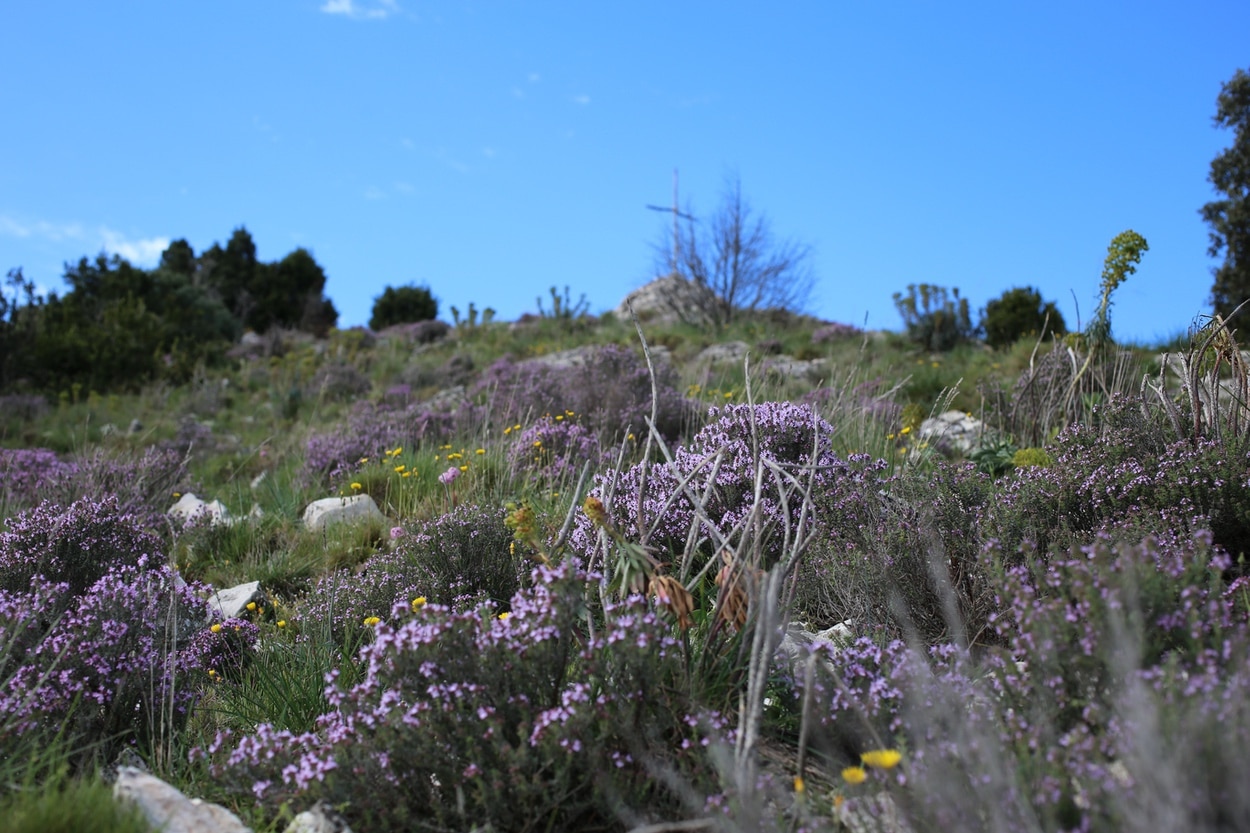
OK, this is home. I was born about 10 miles from here. We are in the southeast of France, the Provence region. And this is the end of the summer. We had a very hot, dry spell, and the plants are suffering. This is the land of resinous shrubs, of pines, holly oaks, junipers, and very strong and aromatic plants.
And you see, today, I’m really excited to talk to you about a big native aromatic remedy—one that is seriously underrated, even though it’s actually very powerful. It’s the plant I use the most throughout the winter. In Provence, we call it “la farigoule”. Let me introduce you to thyme, of course!
Stay with me—we’re going to take a deep dive into this remarkable medicinal plant and its many properties, much appreciated in French herbalism, and you’ll see just how useful it can be. I will quote some well-known and experienced French herbal doctors to show you how much reputation this little guy carries. I will share with you my clinical experience as well.
This episode will not be a short one, which is good because I do not want to take shortcuts. And by the way, a lot more is coming on this channel, and I will only do deep dives, so if you don’t want to miss future episodes, you know where to click! (Subscribe in the video window).
Before we start, you should know that I am not a doctor, neither a pharmacist nor a healthcare professional. And this episode is not a substitute for medical advice. Always consult a qualified healthcare provider before using herbal remedies, especially if you have a medical conditions.
That being said, let me start with a story.
Case study 1: urinary tract infection
A few years ago, a client of mine called me. She was undergoing chemotherapy and was completely exhausted and depleted by the cancer and by the treatment. She was in between two chemos, so we didn’t have to worry about plant-drug interactions. Her weakness was the urinary tract; she was getting recurring cystitis. Every two to three months she would get a new infection. And this always ended up with antibiotics.
Her immunity, gut flora, and vaginal flora were obviously damaged. So she called me to make an appointment to start the long-term work, and I had not seen her yet. But a new UTI was starting! And she asked for my help. I asked her what she had in her cupboards in terms of plants. Nothing. But she lived in Provence, and she knew where to find thyme. So I told her to gather some time and drink the tea.
How many cups, she asked? Many! One every couple of hours, at the end of the day you will have consumed probably 5 to 6 cups. How much thyme per cup? Enough to make the tea strong-tasting, strongly aromatic, but still drinkable. And I told her to go see a doctor if the situation got worse or if the situation did not improve in 48 jours.
Two days later, no sign of infection. Gone. That is thyme, folks. Immune stimulant, hot, circulatory, major antibacterial, antiviral, antifungal, with affinities for the gut, the lungs, and the urinary tract. Shall we get into the details now? I think so!
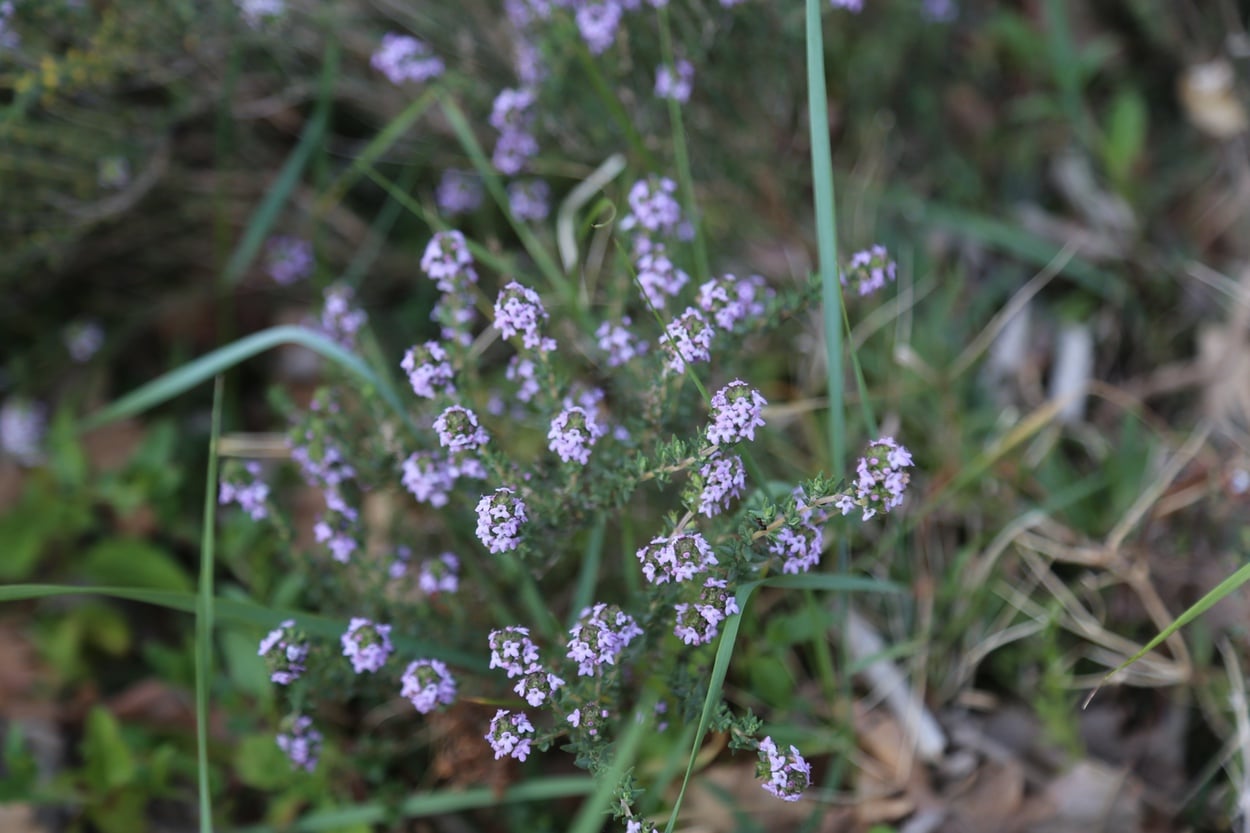
The plant, we call it «common thyme» or just «thyme» (Thymus vulgaris). It belongs to the Lamiaceaes, that big family of aromatic plants that includes rosemary, savory, lavender, oregano, lemon balm, mints, and much more.
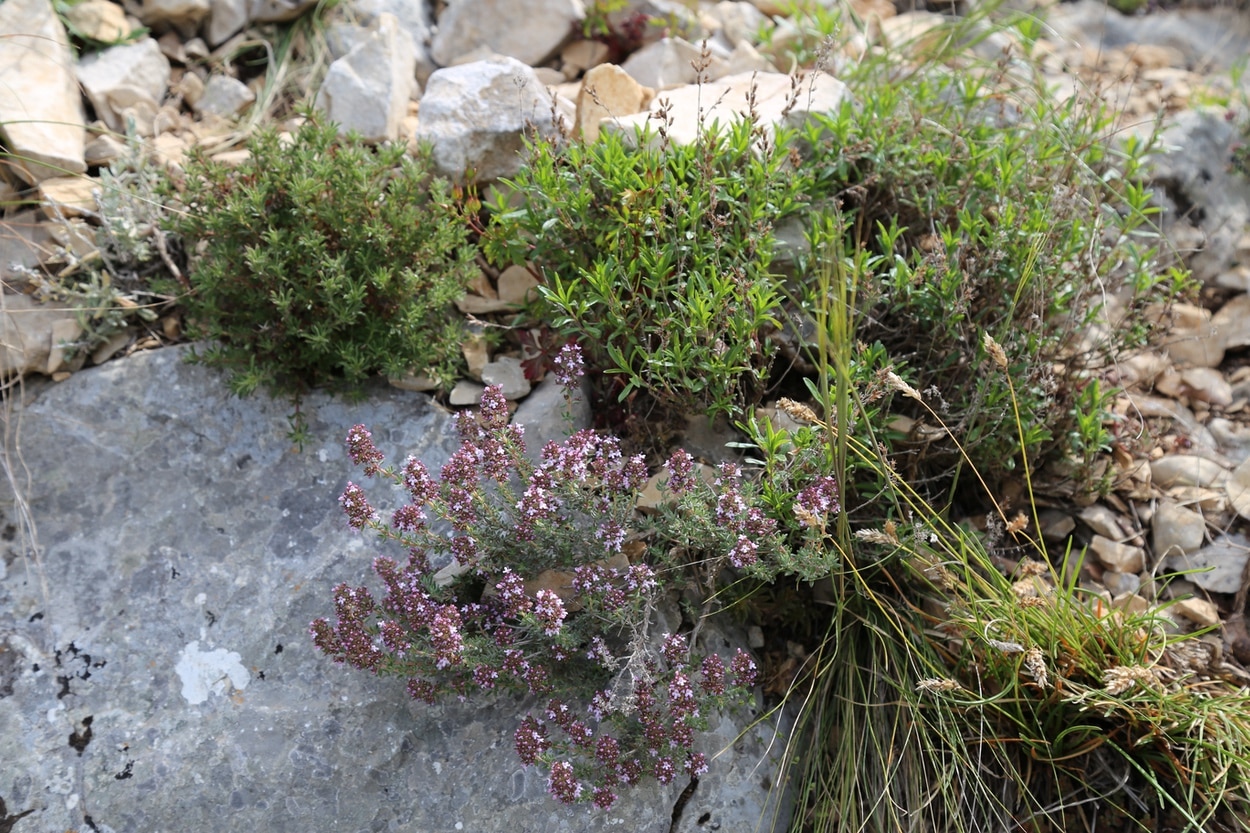
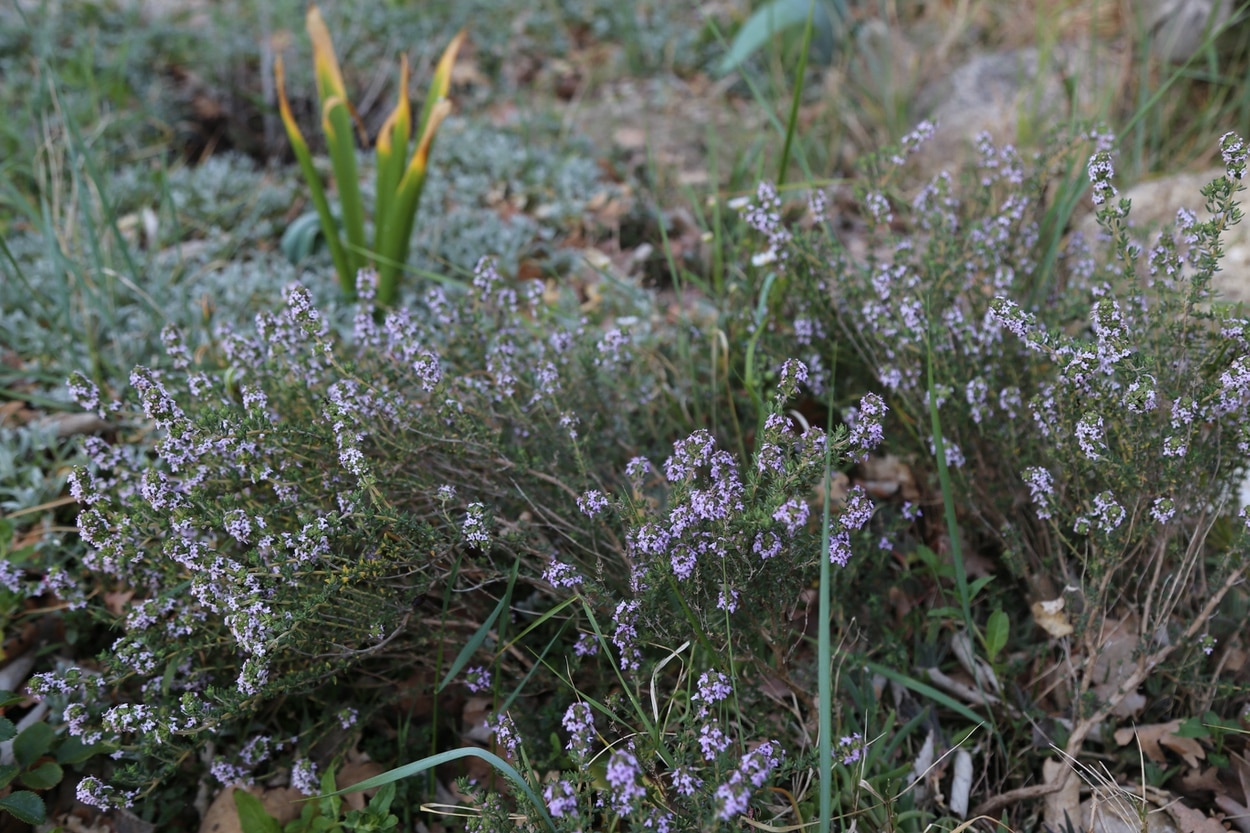
Thyme is a small perennial shrub with tiny gray-green leaves. As the plant ages, it gets woodier—which is perfectly normal—and if you grow it in your garden, you’ll learn to prune it to encourage fresh growth and keep it from becoming too woody. But be careful—if you cut it back too aggressively, you can weaken the plant, and it might not grow back.
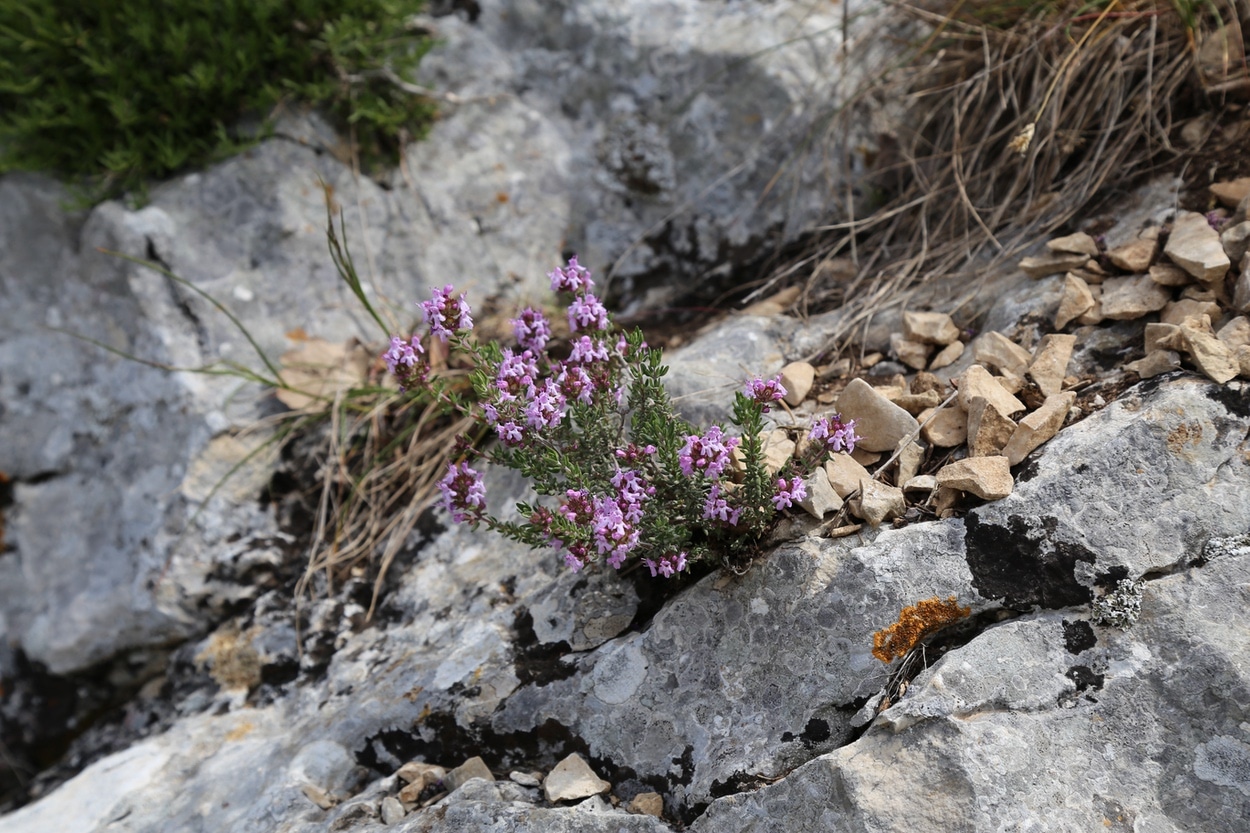
We harvest the leaves and the tiny flowering tops, ideally at the beginning of the flowering period. Most of the time, when we pick leaves of medicinal plants, we wait for the beginning of the flowering period because it’s a time when the plant maximizes production of constituents in the aerial parts. But honestly, I also pick thyme whenever I need it, year-round. It’s such a useful plant. If you have it in your garden, I’d rather pick it fresh outside the «ideal period» than use dry, older thyme.
Now, don’t pick just after a rain, or the plant won’t be as strong. Pick during dry periods, and pick early in the morning just after evaporation of the morning dew.
Note that we’re really after the leaves with flowering tops, ideally, not the older, thicker, woody stems. If the stems are tender, no problem—keep them in your preparations. If they’re tough and woody, try to remove them, or you’ll end up with very coarse, tannic-tasting preparations that kind of get stuck at the back of your throat.
If you want to build some stock of the dried plant, the easiest way to harvest is to grab a bunch of branches and cut at about two thirds of the branches, leaving one third on the plant. Then you lay them flat on a rack to dry. Or much better, you can put them in a big paper bag; they have to be loose in the bag, and you need to be able to turn them during the drying process. As you turn them, the leaves will detach and end-up at the bottom of the big bag. That’s it. That’s where you go get your tiny dried leaves, at the bottom of the bag. Store in a cool, dry place. They keep for at least a year if the plant is quite aromatic. Sometimes more.
Now, one of the big questions everyone asks: is garden thyme as strong as wild thyme?
The answer is a definite no. If you came to see the thyme in my hills in Provence, you’d find it growing in extremely dry, sunny spots—sometimes from a crack in a rock with barely a pinch of soil. That thyme struggles to survive—and it’s incredibly potent. Like grapes to make wine, aromatic plants need to struggle to bring out their best in terms of essential oils.
The chemotype tends toward the phenols in my region (thymol and carvacrol). For those of you American herbalists, the closest wild plant that I met and that had a similar chemotype was wild Monarda fistulosa growing in very hot places, poor soil, in the southwest US.
Please note that I am not going to talk about thyme essential oil in this episode. Because if the essential oil has a phenol chemotype, it is very strong and aggressive and comes with precautions. And we have different thyme chemotypes in French aromatherapy, and they are almost like different remedies. So let’s keep that out of this discussion. For this episode, we are just talking about the whole, non-distilled parts.
So yes, wild thyme in my hills, super strong. But don’t let that discourage you from growing thyme in your garden. In my experience, garden thyme may be less potent, but it’s still incredibly useful. So grow thyme in your garden. Full sun, well-drained soil—add a little sand if your soil is clay-heavy. If you can, plant it against a south-facing wall and surround it with stones to store the heat—thyme loves that. It does require a lot of sun to give its best.
The only problem with thyme is that… it’s considered a cooking herb! As Bernard Peyrilhe, an 18th-century medical professor teaching in Paris, said: “Thyme is a very active plant, less used in medicine than it should be—probably because the idea of a condiment excludes that of a medicine.” In other words, if it tastes good on your plate, it can’t possibly be good medicine, which is, of course, completely wrong.
When you drink thyme tea or chew a few leaves, what comes through is its warmth and stimulant effect—like it has stored up all that summer sunshine and is giving it back to you. The energetics of thyme? Clearly warming and drying.
In terms of constituents, it contains:
Its oldest and most famous use is for fighting off colds. When you feel that first chill that tells you an infection is coming—thyme is your best friend. Simple use: several cups of thyme tea throughout the day. It’s a major protector of the lower respiratory tract, the lungs. It will protect against any type of respiratory infection, upper or lower, but it does have an added strong affinity for the lungs.
A great combination is ginger root, fresh and grated, one small teaspoon, plus a few sprigs of thyme if fresh, or a teaspoon (or more) of the dried leaves. Add lemon juice once the tea has cooled down a bit, and maybe some honey. Delicious and quite effective.
If the cold turns into bronchitis, keep going with thyme. And even go stonger. Aromatic compounds from the tea are absorbed in the gut, enter the bloodstream, and are excreted into the lungs, where they help you fight bacteria and viruses. Also, it thins the mucus, it makes it more liquid, less thick and pasty, and it helps with expectoration. We use the terms «mucolytic» and «expectant».
This is especially useful toward the end of the bronchitis when the person is tired of coughing so much, the mucus is thickening and not being expelled very well, making the person at risk of relapse.
Drink it regularly throughout the day—not just two cups! Make a full liter and sip it often.
Another great combo here, especially for the lungs, is thyme + licorice root. In your thyme tea, you can add one-third of a teaspoon of licorice root powder, for instance (if you don’t have contraindications for licorice). Licorice supports the immune system, modulates inflammation in the bronchial tubes, and helps with expectoration as well, with moistening energetics.
And as always—if your condition does not improve, go see your doctor.
It will have a stimulant effect on immunity. Jean Valnet, one of our deceased herbal docs, said that it stimulates the making of leukocytes (of white blood cells) during infectious diseases.
I’d like to go back to coughing for a second. Because we need to be precise here. You see, you might think that time is a bit of an irritant, and that is how it kicks the lungs into action, making it produce more mucus. But it’s more subtle. Thyme is a cough regulator. It stimulates mucus production and coughing when needed, when the cough is productive, and when there is mucus to expectorate.
But it also helps contain the cough reflex when you have a dry cough. It could be the dry, irritative coughs of children; it could be the inflammatory cough caused by allergies. You see, it is a strong antispasmodic that seems to act on the cough reflex itself, which is kind of a spasm when you think about it.
Thyme was often used to relieve whooping cough, which is very spasmodic cough in nature.
Let’s take a further step back. Here in France, thyme is positioned as an antispasmodic of the overall respiratory tract. Do you know other types of spasms in that system? If you think asthma, you are correct. It was used for asthma in the past. It was used for emphysema as well here in France. Still is. So… thyme as a balancer of lung function. We could think of great lung tonic herbal mixes containing thyme, mullein flowers, a bit of licorice, elecampane may be…
One last indication from Eric Lorrain, a French herbal doctor: thyme to calm the inflammation of the respiratory mucosa provoked by inhalation of bleach fumes. That one is interesting.
I will finish this section on thyme and the respiratory tract with my own story.
About 15 years ago, I caught a major bronchitis. I was exhausted, and I did not take care of myself very well. Sure, I used herbal remedies. But not often enough. Not strong enough. I forgot to take them every couple of hours. You see, I was busy; I was running around. Well, I was trying to make a living out of my herbal activities and was pretty darn stressed. And bam, the viral bronchitis turned into a bacterial bronchitis. Fever, trouble breathing. I had a course of strong antibiotics and cortisone. I got better. And then, a week later, I started to feel worse again.
At this point, I lined up my best remedies: thyme, for my teas. Propolis tincture, to add to my tea. I was growing grindelia back then, and I had a very strong grindelia tincture. I was growing hyssop. My base was a tea blend: thyme + hyssop. Then I added 20 drops propolis tincture, 20 drops grindelia tincture. One cup every two hours. Ad nauseam. I swear, I could not stand the smell of thyme after a few days. But I got rid of that nasty infection.
Then, for about 5 years, every winter, if I didn’t drink my thyme tea, I would start to get lung inflammation and a productive cough. Astragalus was also a big savior as a lung protector. You see, my lungs had been severely damaged, scarred, weakened. For 5 years, I had to be very careful; I could not let my guard down. But thanks to thyme and astragalus, I could avoid any further lung problems.
OK, next indication. As I explained with my little story at the beginning of the episode, very useful in any type of UTI. Be careful that this does not evolve into a kidney infection (what we call pyelonephritis). So don’t wait too long; go see a doctor if things do not improve.
And here again, frequency and dosage will make all the difference. When we put a program in place, if the condition is very acute, it’s got to be high frequency with good, strong preparations. And when you have a UTI, it’s good to drink lots of fluids. So here, the tea form, what we call «infusion» in France, will be the most appropriate. We’ll talk about tinctures and other forms in a minute.
Eric Lorrain mentions that thyme will work on E. coli even when the strain is resistant to antibiotics. If the UTI seems to be antibiotic resistant, think of thyme, think of juniper (and that information, we got it from the great Stephen Buhner), think of propolis as well. A thyme infusion with some added juniper and propolis tincture, a very good idea.
Good combinations for UTI: thyme + heather (we’ll talk about heather in another episode). More generally, a lot of plants in the Ericacea familly will help, like bearberry leaves. Good combination with diuretic plants like goldenrod. Hibiscus is quite good here as well, etc. I will present all of those plants in future episodes.
Thyme is reliable for bloating and cramps, as a simple digestive tea, while also balancing gut flora. It will have a clean-up effect on pathogenic strains in the gut flora.
Useful for oral or intestinal candida, traveler’s diarrhea, and more. If you look for an antibacterial or antifungal for a lingering gut infection, maybe you’ve been to Peru, Chile, and Bolivia like I did a few years ago, and you did not come back home alone! There were some new hosts in your digestive tract!
Thyme will be of use until things improve, maybe with walnut leaves, berberis root bark, etc.
Since it’s such a major disinfectant thanks to its aromatics, it can be used for gingivitis, periodontitis, whenever there are pockets of infection in the mouth causing inflammation. As a mouth rinse of the concentrated tea.
The last major use I’d like to mention is as a tonic. In a future episode, I will explain what type of tonics we have traditionally used over here in France. I will also define that term «tonic» because it is not well understood.
I will mention several categories of plants that have a clear tonic action: the purely bitter tonics, the hot aromatic tonics in the lamiaceas, the aromatic-bitters from the roots of certain apiaceas, and the aromatic-bitters from certain asteraceas. If this sounds pretty cryptic, don’t worry about it; I will spend a lot of time explaining all of this in a future episode dedicated to tonics.
For now, let’s just say that thyme was used when the person was going through periods of serious fatigue. In the past, this type of fatigue was due to long or severe illnesses.
Today, we can use tonics for chronic fatigue states, for burnout states, the physical fatigue leading inexorably to mental fatigue, loss of motivation, and if it continues, depression. Thyme, just like other hot, aromatic Lamiaceaes like rosemary, savory or oregano, has a reputation for kicking the machine into higher gear. Don’t expect quick results, but integrated into a program for chronic fatigue states, thyme can help.
I will quote Henri Leclerc, one of our great French herbal doctors: «Thyme acts on the circulation and on the nerve centers in a way that manifests as a greater pulse amplitude, increased physical strength, and improved morale.» Not too bad for such a common plant!
Quickly, some other uses :
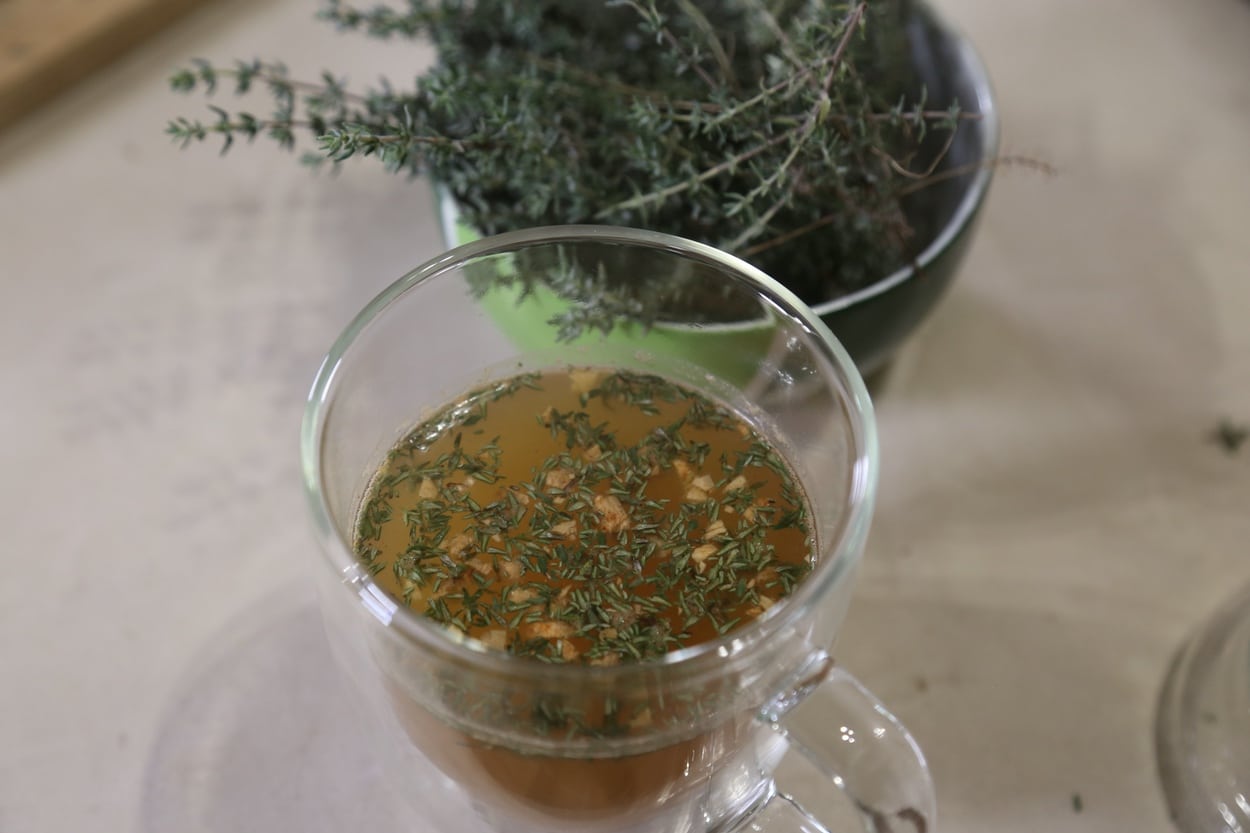
In terms of preparations :
In terms of contraindications and precautions. We’re talking traditional herbal preparations here—not thyme essential oil I remind you, which has its own safety rules.
Contraindicated during pregnancy or breastfeeding, due to lack of data. And here, you may ask: What about the fact that I add thyme to my vegetable stew? What about that blend in the tea bag I drank the other night at a friend’s place, it had some thyme in it. That should be considered as «safe». Yeah, I know, but sorry, today, we cannot draw a clear line between what would constitute a condiment and a herbal remedy. That’s the way it is.
Caution if gastric or duodenal ulcer, or gastritis, a concentrated thyme preparation could temporarily aggravate symptoms.
Some people who handle thyme daily—like pickers and growers—can develop skin or respiratory allergies.
One animal study suggested high-dose thyme extracts could reduce thyroid activity, but the doses were unrealistic, and there’s no evidence of this in humans.
And finally, some sensitive people could have some digestive upset and nausea if the thyme preparation is a little too concentrated.
Overall, you can use strong preparations for short-term use, but if you wanted to use it long-term, lower doses, integrated into a blend, will be much better.
So there you have it—Thymus vulgaris, common thyme. Common, yes, very common in the gardens, in nature around here, but what a useful plant. Personally, I couldn’t get through a winter without thyme.
If you liked this video, please subscribe to my channel and share it with anyone who might benefit. See you soon for another episode of The French Herbal.
One Response
Thank you, I appreciate this information and will begin to use and follow this information. I grow thyme in my garden and always wanted to find other ways of using thyme.