If you’ve ever wondered how to turn your bulk herbs into herbal remedies, this book is for you.
Today, we’re diving into Making Plant Medicine by Richo Cech. I am hoping you will understand who Richo is and why he’s an authority on making plant medicine. We’ll cover what’s actually inside this book and why herbalists have been keeping this manual handy for over 25 years.
First, here is a bit of background on how I came across this book.
I am a big fan of Strictly Medicinal Seeds, a medicinal seed company created by Richo Cech, the author of the book. I don’t know when exactly he created his company, but it’s been a while. It is family-run, organic certified, and it carries values that I care about. I trust them. I was a client when it was called Horizon Herbs. And I grew a whole medicinal garden thanks to their outstanding seeds. I cultivated around 120 species at the top of my gardening years.
When you grow, pick, or buy bulk herbs, you need good, solid reference books on how to make your own herbal remedies. Those references need to be written by people who have done it over and over again. They made so many gallons of tinctures, syrups, and oils that they know the process inside out. They messed up some batches. Because errors are important too. And they kept going.
In the 2000s, when I got into herbalism in the US, there was one reference we were all using to make tinctures. Everybody knew it. Everybody used it, to my knowledge. It gave you the right ratios and alcohol percentages. It was Michael Moore’s Materia Medica. It was so foundational, that I asked Donna Chesner, Michael’s wife, if I could translate it into French and make it freely available to my French readers. Michael had passed away, and Donna kindly agreed. Michael Moore’s work should not be constrained by any frontiers.
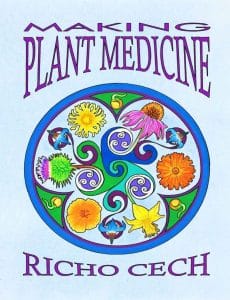
There was nothing in a book format. Until Richo wrote “Making Plant Medicine” in the year 2000. I mean, there was also James Green’s book (we’ll talk about it in another review). But I think that was it. If you have other books in mind, published in the early 2000s, on making herbal remedies, with detailed methods, please let me know and I will update the article going with this episode.
I bought my copy of Making Plant Medicine in 2007 I believe. And I have been using it since then. That little guy has 20 years of use.
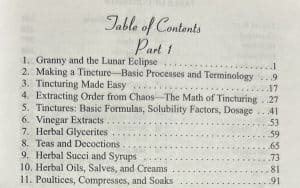
The book (or at least my version of the book) is 276 pages long, organized into two main sections: the methods and the formulary.
The first part teaches you the methods. That is the starting point of the reflection. Plants are secondary to the methods in this first part. Richo explains how to extract medicine from plants using seven different techniques. Each one has a specific purpose and is explained in a lot of detail. If you are a beginner, you will be able to follow along. If you are an experienced herbalist, you will probably find new, interesting information.
Tinctures are the star of the show. Tinctures use alcohol to extract both water-soluble and fat-soluble compounds from herbs. Richo presents two approaches to tincture making. The first one, the so-called “folk method” is what your grandmother could have done: loosely fill a jar with herbs, cover with alcohol, wait, strain, done. Simple.
The problem is inconsistency. You don’t really know what strength and concentration you’re getting. Is this batch stronger than the last? Weaker? You don’t know because you did not measure. That said, the folk method is perfect for beginners and home medicine makers. Low stakes, forgiving, works fine for common and safe herbs.
Next, he explains the weight-to-volume method. Here, we are getting into something more accurate. This is the method I have used from the start, because it is a lot more accurate and reproducible for a professional practice. Here, you get the exact ratios for fresh herbs, usually 1 part herb to 2 parts alcohol. For dried herbs, it is 1 part herb to 5 parts alcohol. The process takes 2-3 weeks with daily agitation when you use dried plants. Why those ratios? Where do they come from?
Well, my understanding is that they are empirical. Generations of pharmacists in the 1800s experimented with different ratios, different alcohol percentages. They compared the different batches. And they came up with optimal ratios. If you put in more alcohol, you won’t necessarily extract more constituents. If you put in less, very often, you won’t have enough solvent to cover the herb. And as you will quickly realize, even with those optimal ratios, one of the challenges is to have the alcohol cover the herbs. And that is a whole separate discussion.
Alcohol percentage will vary according to plant constituents. If a plant contains a high amount of terpenes (which means mostly aromatics and/or resinous compounds), a high percentage of alcohol is required. An example would be grindelia. If a plant contains a high percentage of alkaloids, then a high percentage of alcohol and a bit of vinegar will optimize extraction. An example would be ephedra. It’s all in the book.
I had been taught to use 96% alcohol for fresh plant tinctures. Richo brings this down to 75%, which, I agree, works very well too and helps us to save on our precious stash of 96% alcohol.
Then we move on to vinegar extracts. They have a shorter shelf life but can be used for those who want to avoid alcohol. Vinegar will never be as good as a combination of alcohol and water for extraction, but they can make pretty good preparations. In the book, we find some examples like a thyme, oregano, elderflower, or calamus vinegar.
Then we go to glycerites, another non-alcoholic extraction method using glycerin. Here again, glycerin is far from being a great solvent, but it will work for certain herbs. You need at least 55% glycerin to prevent bacterial growth, and dosages of the final product will be higher compared to tinctures. In the book, we find some examples like fresh chamomile flowers, fresh echinacea root, dried elderberries, fresh jiaogulan leaves, and more. I have made all of those, and they taste great.
Teas and decoctions are next. They are the simplest methods. These are your everyday preparations. Everything you need to know is in the book.
Next, we move on to syrups. If I simplify, they are pretty much a mix of a strong herbal tea or decoction with honey or sugar.
Then we move on to oils, salves, and creams for topical applications. Herbal oils involve infusing plants into oils at precise temperatures. Then, with the right amount of beeswax, we can turn oils into salves. We can also make an emulsion with an oil and a water-based preparation, like a hydrosol, to make a very simple yet very pleasant cream.
What makes all these methods reliable is that Richo insists upon meticulous record-keeping (to enable you to repeat successful batches), precise measurements, and understanding the solubility of different plant compounds. So he makes you think and become independent along the way.
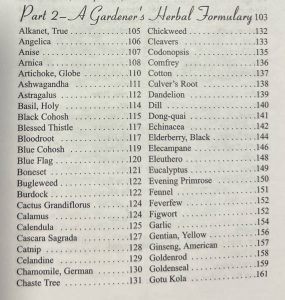
The second part of the book covers the plants. So the plant is the starting point of the reflection; preparation methods are secondary. For each plant, Richo gives us the best preparations.
He covers over 100 medicinal herbs. Some are specific to an American-based practice, like yerba mansa or goldenseal. But most are well known in a European practice. For each herb, he gives us which parts to harvest and why, specific extraction methods for that herb, recommended dosages, contraindications and safety concerns, and conservation status because he cares about sustainable harvesting.
Herbs covered include echinacea, ashwagandha, valerian, lemon balm, comfrey, and many others you’ve probably never heard of but might need someday.
What makes this book special to me is that you feel the experience. Richo hasn’t just read about herbs. He has grown them, extracted them, refined the methods, documented what works and what doesn’t, when I was still in herbal kindergarten.
Let’s talk about what actually happens when you have this book by your side.
Let’s say you have grown echinacea in your garden for immune support during the winter. We are in October or November; you have dug a couple of plants to use the roots.
You turn to the formulary section and find all the information you need. I am not going to read the whole section, but just some extracts to show you how rich and precise the instructions are.
You see, in a few paragraphs, we have learned so much. First, about how to taste a good echinacea preparation. Then the fact that we can tincture the seeds to obtain a very strong preparation. That the fresh plant can be turned into a glycerite. And that chewing a small part of the root is as effective as any preparations. And last, the fact that the dried herb does not last long in storage.
The book covers contraindications. Maybe you’re taking certain medications, or you have certain health conditions. Should you use echinacea? The book tells you very briefly. Now, please note this is not a clinical herbal book. For clinical strategies, dosage, risks of interaction with drugs, or other considerations, this is not like a Mills & Bone (which I reviewed in a separate episode on my channel). It is a medicine-making book and should be used as such.
At $24.95, this is one of the lowest-cost investments you can make in actual herbal expertise. Check the ratings on different online stores. Check the comments and reviews from owners of the book. This is good stuff.
Simple, no frills, just useful information,
And that’s it for now. Thanks for listening. I will see you very soon for the next episode of TheFrenchHerbal.