
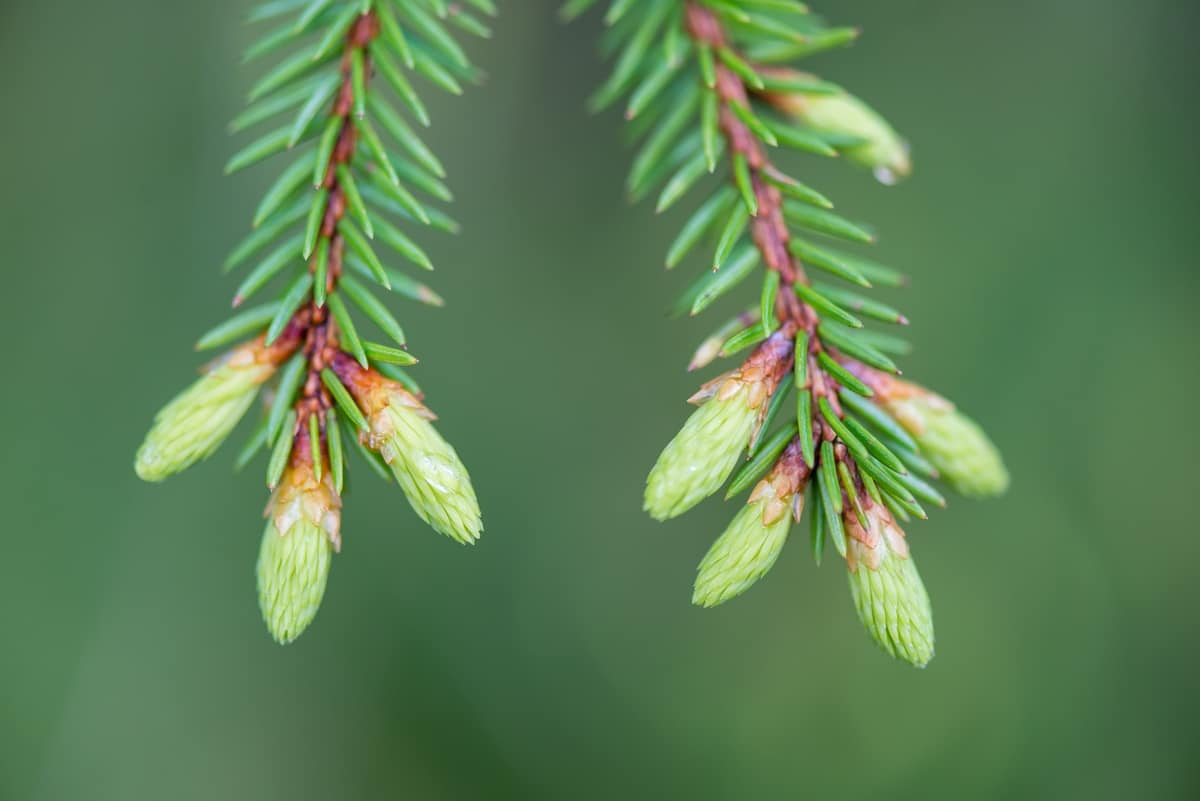
There is one plant you will find in many herb stores in France. And in many herb cabinets at home around the world. Pine buds. And not just pine. Spruce buds. Fir buds. Buds of many conifers. They are all good, all full of resins.
But good for what exactly? Well, that is the subject of today’s episode. I will tell you how to prepare them, what to use them for, and why a tiny bit of alcohol could make all the difference when you prepare a tea of it.
Before we start, a quick but important reminder: I am not a doctor, pharmacist, or licensed healthcare professional. The information shared in this episode is for educational purposes only. It is not intended to diagnose, treat, or cure any condition, and it does not replace professional medical care. Always consult your physician before starting any new herbal protocol, especially if you are pregnant, nursing, or taking medication.

So let’s talk about the buds of conifers. I will mainly talk about pine buds, because that’s what we use in France. But in your region, it could be spruce or fir or larch.
Just for pines, we have more than a hundred different types on the planet, located mainly in countries of the Northern Hemisphere. All those conifers have been used as medicinal plants since time immemorial.
Where I live in Provence, I have mostly Aleppo pines (Pinus halepensis). As soon as you climb a bit higher in altitude, you begin to see the Scots pine (Pinus sylvestris). Further up in the Alps, you see fir and spruce. Let’s not forget that herbalism used to be a very local practice. People picked what they had around them. That’s why which conifers were used depended on the region.
In French herbalism, we generally use the buds of Scots pine. That’s what you will see in herbal stores. Fournier, a renowned author in French herbalism, explains why. He says that the other buds are rarely used in commerce because they tend to be smaller. So ultimately, it’s probably a question of weight, since you sell dried herbs by the gram. You want the bigger ones and sell more of them.
But forget about the rules of commerce. This interchangeable aspect of the different conifers is confirmed by Cazin, one of our famous country doctors from the 1800s, who explains that “the buds of all pine and fir species can be used with more or less the same advantages.”
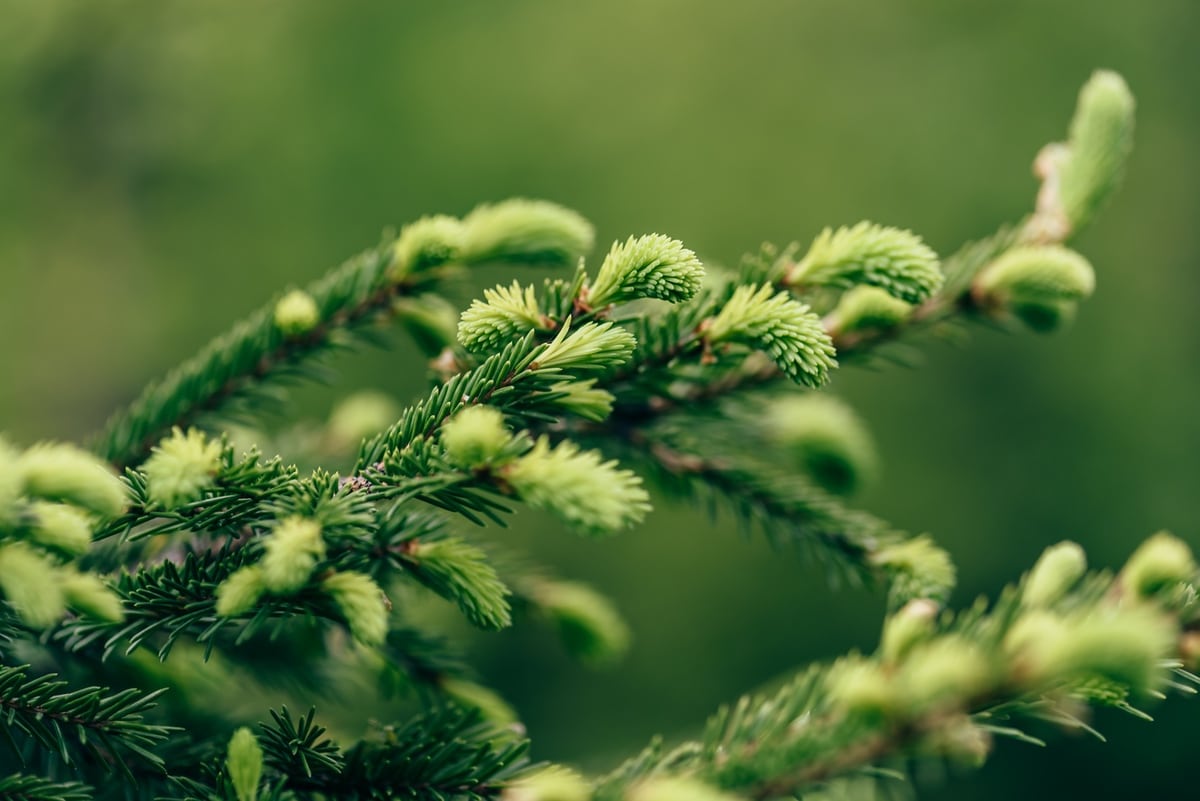
One last important point: I will just use the term “buds” but know that you can also use the young shoots, which is the phase of growth just after the bud, when the shoot is still young and tender.
Harvesting is a delicate mission. It is generally done during the dormancy period in late winter, say around February/March depending on the region.
The bud must still be very resinous at that time, sticky, and it hasn’t yet opened. Now, please keep in mind that this is an operation that will greatly weaken the tree, so you don’t do it just any random way. Ideally, harvesting would be done only on trees that have been felled for lumber production before the trees go to the sawmill.
Otherwise, you only harvest from lower branches so as not to prevent the tree from developing upward. Also, regulations vary by region. So always check with your local or national forest or park services before picking on public land; it might not be permitted.
Then you let them dry and keep them in brown paper bags for later use.
In terms of constituents, you have noticed that those buds are very sticky. We are in the world of terpenes. The buds contain :
The energetics of the overall buds are warming and drying. There is a stimulating aspect of those resins.
As for the essential oil fraction, well, it’s got this fresh lemony scent that feels like it’s pretty cooling and grounding to me.
OK, now let’s talk about properties and indications.
The most interesting property is related to lungs and bronchial tissues.
In old French writings, we see that pine buds are specifically indicated for catarrhal states. The term is important to understand, as it’s no longer really used today. It was used to describe a situation in which there’s an inflammation that causes excessive secretion of the mucous membranes.
Why are the lungs inflamed? Well, this could be due to something that chronically provokes or injures the lungs, like toxic fumes or tobacco smoking. You see those catarrhal states in the person who has COPD for example, especially in the morning upon waking. COPD stands for Chronic Obstructive Pulmonary Disease.
Or it could be due to allergic reactions, like allergic asthma. Or it could be due to a lung infection.
To put it in simpler terms, whatever the cause is, we are talking about a wet, productive cough.
Pine buds will have two very interesting properties here:
So we need to be clear here. We are not talking here about dry cough, nervous cough, or an allergic scratchy throat. We’re talking about a wet cough with congested bronchi and abundant mucus production that must be evacuated to facilitate healing.
Here, the buds would need to be taken for a certain period of time of there is an infection, potentially 2 to 3 weeks or until resolution. And if there is a chronic issue, it could be taken in the morning to help clear up the lungs, in the case of COPD for example.
Another classic use is for urinary tract infections, what we call cystitis. I already talked about thyme for UTIs. I explained to you that in my experience, it was very effective. Well, you can add pine buds to the list.
The resins are quite interesting here, cause they will bring a slightly different disinfectant effect from the others herbs you may know, like bearberry or heather. It’s always good to have plants that have the same properties but act in different ways, through different constituents. Then you can combine them to increase the effectiveness of a preparation.
And let me give you my little secret here. When I work with a woman that has chronic UTIs, I like to combine one plant from the Ericaceae family (heather is my favorite one), one aromatic plant that is rich in phenols (like thyme or oregano), and one plant rich in resins (like pine buds, grindelia, myrtle, or propolis – which is technically not a plant but very rich in resins). The combination, very effective.
You can apply pine buds preparations externally to relieve joint inflammation and to calm skin inflammations.
In this context, you have to make sure the resins are extracted. You can make a classic oil maceration. That is, simply cover the buds with a vegetable oil like olive oil, and let it macerate for 4 to 6 weeks in a warm place. But it’s very poor for extracting resins.
Instead, I recommend using a method that has been described by Michael Moore. I will have to make a full episode on that. Here is a quick summary that I adapted to my needs. You crush your dried buds, or cut them into tiny pieces, or grind them if you are not afraid to mess up your grinder (because those resins, they stick). Then you moisten them with 96% alcohol (which is 190 proof alcohol for you American folks). You cover them, let them stand for about 1 hour. Then you add the oil. The transfer of the resin from the alcohol to the oil will take place immediately. Stir well, let it stand for another hour. Then stir again and strain through a piece of cloth. The remaining alcohol will float over the oil. It will take a couple of days to evaporate. That’s it. No more alcohol, just an oil rich in resins.
And you know what, if you have pure resin from those trees, you can dilute (a better term would be “dissolve”) it into 96% alcohol, and just pour that liquid into olive oil. Again, the alcohol will float over the oil, you just wait until the alcohol has evaporated, and what’s left is an oil very rich in resins. And that is so good for joint and skin issues.

One last interesting piece of information: the young shoots are very rich in vitamin C, which is always a plus during the winter period or at the beginning of spring. You can eat the shoots directly when they are still very tender.
How much vitamin C is in each bud? I couldn’t tell you; I don’t have the information. But I know that when boats full of people arrived on the American continent in the 1700s and they all had scurvy, the Native American tribes gave them young shoots of conifers to heal their scurvy. If it works for scurvy, it probably works for weak immune systems due to a lack of vitamin C.
In terms of forms and quantities.
The classic preparation you’ll find in classical French herbals is the tea of the buds, with 20 to 30 g of dried buds per liter of water.
So if you make a tea for one cup of 250 ml, that gives you about 5 to 7 g. You pour boiling water and let it infuse for 10 minutes. It’s very poor for extracting resins because water isn’t a good solvent for resins.
In some books you’ll be told to boil the buds for 10 minutes, so a decoction. That’s already a bit better.
But I’m going to give you a great trick if you don’t mind a bid of alcohol to extract the resins.
Compare the two methods. Make a normal tea with boiling water, then make this version and compare the resinous taste at the end. You’ll see there’s a huge difference.
Another form you ca prepare is a dried plant tincture. Use the 1:5 ratio described by Michael Moore or Richo Cech in his book “Making Plant Medicine”. Ideally, you would use 60 or 70% alcohol since the buds are so rich in resins. But this type of alcohol is hard to find in France, so I often use 50% rum, for instance. So you use 500 ml of alcohol for 100 g of dried buds, let macerate for 2 weeks, then strain. This will make you an excellent tincture to add to your herbal teas for the lungs.
For example, in case of lung infection, you can make a thyme or eucalyptus or hyssop tea, then add about 20 drops of pine bud tincture. Repeat as necessary.
By the way, I don’t know if you heard of a famous Swiss naturopath named Alfred Vogel. He did much for the revival of herbal medicine in Europe in the last century. Vogel explained that if you’re prone to this type of bronchial problem, find some conifer in your garden: pine, fir, larch. Try to find buds that are opening or still closed, pick a few, and chew them slowly during the day. Your problem will disappear in a few days.

In terms of precautions:
Other than that, this is a great home remedy, very useful, quite powerful to expel some of that old gunk stuck in your lungs and restart the healing process.
Thanks for being here. I will see you very soon for the next episode of TheFrenchHerbal.